
You call your dog’s name for the third time, treats in hand, but they remain frozen in place, eyes wide and body stiff. A neighbor might dismiss it as stubbornness, but your intuition suggests something more. What many dog owners in The Woodlands don’t recognize is that their dogs are in a constant state of communication through tail position, ear angle, and muscle tension. Without understanding this non-verbal language, you and your dog are essentially speaking different languages in your own home.
Understanding dog body language is more than just preventing bites or recognizing happiness. It is the foundation for successful training, peaceful walks in Montgomery County, and calm interactions with visitors. At The Mannered Mutt, we have helped countless dog owners in Conroe transform their relationships by teaching them to interpret their dog’s signals. Paulina, our Master Trainer certified since 2012, asserts that reading canine body language is the most critical skill for any dog owner.
This guide will equip you to decode your dog’s subtle signals, identify stress before it escalates, and distinguish between a relaxed dog and one who is merely coping.
What Is Dog Body Language and Why Does It Matter?
Dog body language is a sophisticated system of postures, facial expressions, tail positions, and movements that convey a dog’s emotional state and intentions. While dogs do vocalize, the majority of their communication happens silently through physical cues that owners often miss or misinterpret. This non-verbal language is a holdover from their wolf ancestors, pack animals who relied on sophisticated communication to maintain group harmony.
For humans, this communication system can be counterintuitive. A yawn may not signal fatigue but stress. A wagging tail doesn’t always indicate happiness; its height, speed, and stiffness can reveal arousal, anxiety, or even aggression. This is why professional dog trainers spend years learning to read dogs accurately, and why misreading these signals is a primary reason for training failures.
According to the American Veterinary Society of Animal Behavior (AVSAB), understanding canine communication signals is essential for preventing aggression, reducing anxiety, and building positive training relationships. Dogs whose stress signals are consistently ignored often escalate to more obvious behaviors such as growling or snapping. At The Mannered Mutt, Paulina teaches every client the basics of reading dog body language before diving into specific commands.
What Are the Key Elements of Dog Body Language?
Dog body language involves multiple physical components working together to create a complete message. Understanding each element separately helps you piece together what your dog is communicating.
How Do Tail Position and Movement Indicate Emotional State?
The tail is one of the most expressive parts of a dog’s body, but it is also one of the most misunderstood. A wagging tail can mean many different things depending on several factors. A high and stiff tail indicates confidence, arousal, or potential aggression. A mid-level, relaxed tail suggests a neutral, comfortable state. A low or tucked tail signals fear, anxiety, or submission.
Wagging speed and pattern also matter. A fast, loose wag with hip movement indicates genuine happiness and excitement. A slow, deliberate wag suggests uncertainty or a cautious approach. A high, stiff, rapid wag indicates high arousal—extreme excitement or pre-aggression.
| Tail Signal | What It Indicates | What To Watch For |
|---|---|---|
| High, stiff, slow wag | Arousal, potential aggression | Body tension, fixed stare, stillness |
| Mid-level, loose, full-body wag | Genuine happiness, relaxation | Soft eyes, open mouth, playful bounce |
| Low or tucked, still | Fear, extreme stress | Whale eye, ears back, crouched posture |
| Horizontal, gentle wag | Friendly approach, mild interest | Relaxed face, normal breathing, soft body |
What Do Ear Positions Tell You About Your Dog?
Ear position varies by breed—erect ears versus floppy ears show differently—but the principle remains consistent. Forward and alert ears indicate the dog is focused and interested. Neutral and relaxed ears suggest a comfortable, calm state. Ears pinned back against the head signal fear, anxiety, or appeasement. This is a critical stress signal that many owners miss, especially in dogs with floppy ears.
How Does Eye Contact and Gaze Reveal Stress or Confidence?
A dog’s eyes can reveal a great deal about their emotional state. Soft, relaxed eyes indicate a comfortable dog with relaxed eye muscles, normal pupil size, and occasional blinking. A hard stare, characterized by direct, unblinking eye contact with muscle tension, indicates high arousal or a challenge. In dog-to-dog interactions, this often precedes aggressive behavior.
Whale eye, also called half-moon eye, occurs when you can see the whites of your dog’s eyes because they are looking away while keeping their head still. This is a classic stress signal. If you see whale eye during training, your dog is over threshold and needs a break. Squinting or blinking rapidly are calming signals that indicate the dog is trying to de-escalate tension.
What Are Dog Stress Signals and Calming Cues?
One of the most important aspects of understanding dog body language is recognizing stress signals before your dog’s anxiety escalates into problem behaviors.
What Are the Most Common Stress Signals Dog Owners Miss?
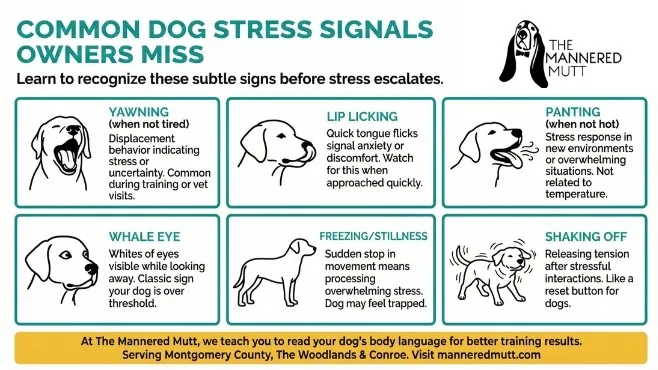
Many dog owners in The Woodlands have worked with The Mannered Mutt after years of missing subtle stress signals. Yawning when not tired is a displacement behavior that indicates stress or uncertainty. Lip licking or nose licking involves quick tongue flicks that indicate stress. Panting when not hot or exercising is another common stress signal. Freezing or going still occurs when a dog suddenly stops moving, often because they are processing overwhelming stress. Shaking off, as if wet, is how dogs release tension.
How Do Calming Signals Help Dogs Communicate?
Dogs use body language as a primary way to communicate with others — both dogs and humans — and certain behaviors appear linked to stress or attempts to prevent conflict. Research shows that dogs exhibit specific displacement and visual signals such as head turning, nose licking, blinking, and lip wiping more frequently when they are in social situations that may involve uncertainty or subtle stress. These signals are associated with a non-aggressive, appeasing attitude that helps avoid escalation and indicates a dog’s intention to remain peaceful rather than threatening.
For example, turning the head or looking away can reduce social tension by signaling that the dog is not a threat, while behaviors like slow, curved approaches rather than direct, straight-on movement communicate caution and respect. Sniffing the ground or brief lip/nose licking are often seen when dogs are uncertain or trying to self-regulate, helping them stay calm in potentially stressful situations.
These calming or appeasement signals form part of a broader canine communication system that allows dogs to navigate social interactions without conflict. Recognizing these subtle behaviors can help you better understand and respond appropriately to your dog’s emotional state.
How Can You Tell the Difference Between a Relaxed Dog and a Stressed Dog?
The ability to quickly assess whether your dog is genuinely relaxed versus masking stress is crucial for training success.
What Does a Truly Relaxed Dog Look Like?
A relaxed dog displays loose, soft body signals. Their body posture includes weight distributed evenly on all four legs, loose muscles, and natural, flowing movements. They may sit or lie down comfortably, shifting positions easily. Their facial expression includes soft eyes with occasional blinking, a relaxed mouth that may be slightly open, ears in their natural resting position, and a smooth forehead.
Their tail and movement patterns show a tail in a neutral or gently wagging position, a body that may have a slight wiggle, and responsiveness to their environment without hypervigilance. At The Mannered Mutt, we teach clients to establish a baseline for their dog’s relaxed state at home.
What Signals Indicate Hidden Stress or Anxiety?
Some dogs mask stress and appear compliant while their body language reveals deep discomfort. These are often the dogs who later “snap” because their earlier signals were missed. Subtle signs such as muscle tension in the jaw, neck, or shoulders, excessive scanning of the environment, shifting weight to the back legs, or a closed, tense mouth can all indicate underlying anxiety that may not be obvious at first glance.
When multiple stress-related behaviors appear together, they are especially important to notice. Displacement behaviors like yawning, lip licking, looking away, or sniffing the ground are widely recognized as appeasement signals that dogs use to manage social pressure and reduce tension. Research observing canine communication has found that these behaviors occur more frequently during potentially stressful social interactions and are consistent with non-aggressive intent, indicating that dogs use them to avoid escalation and cope with discomfort.
Recognizing clusters of these signals, rather than isolated actions, helps owners identify when a dog is uncomfortable or anxious rather than simply misbehaving. This is why Paulina emphasizes body language literacy. Catching stress early can prevent escalation into more serious behavior problems.
How Can Learning Dog Body Language Improve Your Training Results?
The connection between body language literacy and training success cannot be overstated. Every training moment is a conversation, and if you cannot read your dog’s side, you are training blind.
Why Do So Many Training Attempts Fail Due to Misread Signals?
The Mannered Mutt regularly works with frustrated dog owners in Conroe and The Woodlands who have spent months trying to train their dogs with limited success. When Paulina assesses these situations, the root cause is almost always the same: the owner was asking for behaviors while the dog was displaying stress signals that made learning impossible. The typical scenario unfolds like this: the owner asks the dog to “sit” while the dog shows whale eye and lip licking. The dog does not sit because they are over threshold. The owner interprets this as stubbornness and increases pressure. The dog’s stress escalates, leading to shutdown or reactive behavior.
The reality is that the dog was communicating clearly that they were too stressed to learn. Professional trainers assess a dog’s body language before, during, and after each training exercise. If stress signals appear, effective trainers lower criteria, increase distance, or change the environment. This is why The Mannered Mutt’s personalized approach works when generic methods fail.
What Changes When You Start Reading Your Dog Accurately?
Dog owners who develop body language literacy report transformative changes. In training sessions, they recognize when to push forward versus when to take a break, understand that “not listening” is often “too stressed to process,” and catch stress before it escalates. On walks, they identify triggers before their dog reacts, know when their dog needs more space, and read interactions with other dogs to prevent conflicts.
At home, they understand when their dog needs decompression time, recognize pain or illness through body language changes, and build a stronger bond. By learning to read your dog’s body language, you can build a relationship based on trust and mutual understanding. You will be able to address stress before it becomes a problem and create a more harmonious life with your canine companion. The investment in learning this skill pays dividends in every interaction, transforming frustration into connection and confusion into clarity. If you need help understanding your dog, don’t hesitate to contact us.
How can I improve my dog's body language understanding?
Learn the basics of canine communication and observe your dog in different situations. Working with a professional trainer can help you spot subtle signals and understand what your dog is communicating in real time.
What should I do if I notice my dog displaying stress signals?
Stay calm and reduce the pressure. Create distance from the trigger, give your dog space, and avoid forcing interaction or training until they have settled.
How can I tell if my dog is happy or stressed during training?
A relaxed dog has soft eyes, loose movement, and normal breathing. Stress shows up as lip licking, yawning, tension, or avoidance. If engagement drops, your dog may be overwhelmed.
What role does socialization play in a dog's body language?
Proper socialization helps dogs feel confident and calm in new situations. Dogs with limited or negative exposure often show more fear-based signals.
How can I help my dog feel more relaxed in stressful situations?
Provide a safe space, reward calm behavior, and use gradual exposure to stressors. Consistent routines and positive reinforcement help reduce anxiety over time.