
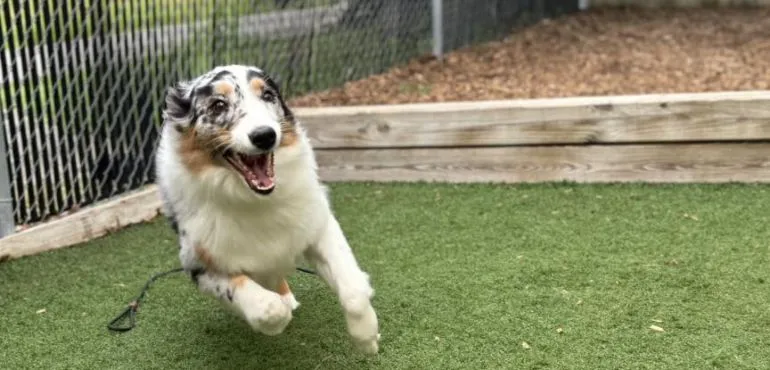
Your dog has been inside all day. By 4 PM, they’ve chewed through a throw pillow, counter-surfed twice, and barked at every car that passed the window. You’re exhausted, frustrated, and starting to wonder if you just have a “bad dog.” Here’s what most dog owners in The Woodlands and Conroe don’t realize until someone tells them: what looks like a behavior problem is often an exercise problem wearing a bad reputation.
Dogs are built to move. Their bodies and brains are wired for physical activity, and when that need goes unmet, the energy has to go somewhere. Unfortunately, that “somewhere” is usually your furniture, your patience, or your evening walk turning into a full-contact sport. At The Mannered Mutt, we work with frustrated dog owners throughout Montgomery County, and one of the first questions our founder, Paulina, asks every new client is simple: “How much exercise is your dog actually getting?” The answer changes everything.
This guide covers what you need to know about meeting your dog’s exercise needs, how regular dog walking and physical activity directly improve behavior, and when professional dog training becomes the missing piece that exercise alone can’t provide.
Why Does Dog Exercise Matter So Much for Behavior?
Most dog owners know their dog needs exercise, but few understand the direct connection between physical activity and behavior inside the home. This isn’t just about burning energy—it’s about how your dog’s brain and body function when their needs are consistently met.
Exercise reduces the energy behind problem behaviors. Excessive barking, destructive chewing, jumping on guests, and relentless pacing aren’t signs of a “difficult” dog—they’re signs of a dog with nowhere to put their energy. Regular dog exercise gives that energy a healthy, structured outlet, and the difference in home behavior is often dramatic within days.
Physical activity supports mental health. Exercise releases endorphins in dogs just as it does in humans, which helps reduce anxiety and stress. Many dogs who appear reactive or anxious are dealing with chronic under-stimulation. A dog on a walk isn’t just exercising their body—they’re processing scents, monitoring their environment, and engaging their brain in ways that no amount of indoor time can replicate.
Socialization during exercise builds confidence. A dog on a walk who regularly encounters other dogs, people, cyclists, and new environments gradually becomes more comfortable with the world. That growing confidence directly reduces fear-based behaviors. According to research from the University of Liverpool, the strength of the dog-owner bond is strongly linked to how consistently owners walk their dogs—which means your commitment matters as much as the activity itself.
How Much Dog Exercise Does Your Dog Actually Need?
One of the most common pet care mistakes owners make is underestimating how much daily physical activity their dog genuinely requires. The American Kennel Club (AKC) emphasizes that exercise needs vary by breed, age, and health, but provides general guidelines.
Most adult dogs need 30 minutes to 2 hours of exercise daily, divided across multiple sessions. Active dogs and high-energy breeds like Australian Shepherds, Border Collies, and Retrievers—sit firmly at the higher end of that range. Smaller breeds and lower-energy dogs may manage well with shorter, more frequent outings.
- Puppies need exercise with important limitations. Short, frequent sessions focused on socialization and light play protect their developing joints while building healthy habits early. A common guideline is five minutes of exercise per month of age, twice a day.
- Senior dogs still need to move. Gentle, consistent physical activity keeps older dogs mobile, mentally sharp, and behaviorally stable. The key is adjusting intensity, not eliminating activity altogether.
| Dog Type | Recommended Daily Exercise | Best Format |
|---|---|---|
| High-energy/working breeds | 90 min – 2+ hours | Long walks, fetch, structured play |
| Medium-energy breeds | 60 – 90 minutes | Daily walks, off-leash time, training |
| Small or low-energy breeds | 30 – 60 minutes | Shorter walks, indoor play, mental games |
| Puppies (under 12 months) | Multiple short sessions | 5 min per month of age, 2–3x daily |
| Senior dogs | 30 – 60 minutes (gentle) | Slow walks, swimming, light play |
If you’ve been saying, “I need to walk my dog more” for weeks, the behavior you’re seeing at home is likely your dog’s clearest possible signal that you’re right.
What Makes a Dog Walk Actually Effective?
Not all dog walking is created equal. There’s a significant difference between a dog who drags you down the street and a dog who walks with purpose, awareness, and calm engagement. The structure of your walks matters almost as much as their frequency.
- Vary your routes to increase mental stimulation. A dog on a walk through a familiar path gets significantly less mental engagement than a dog exploring a new trail or neighborhood. New smells, sounds, and terrain require active brain processing—which is genuinely tiring in the best way.
- Use walks as mini training sessions. Every time you ask your dog to “heel,” “sit” at a crosswalk, or “leave it,” you’re reinforcing obedience in real-world conditions. Incorporating commands into your daily dog walking routine strengthens training far more effectively than isolated sessions at home.
- Let your dog sniff—but on your terms. Sniffing is mentally exhausting for dogs. Allowing structured sniff breaks gives your dog important cognitive stimulation while you maintain control. Paulina teaches this balance in every Private Lessons program at The Mannered Mutt: the walk should be enjoyable for your dog and manageable for you.
What Are the Best Indoor and Outdoor Exercise Ideas for Active Dogs?
Texas weather in Montgomery County isn’t always cooperative. Having a full toolkit of indoor and outdoor options ensures your dog stays active regardless of conditions.
Indoor exercise options that actually work:
- Fetch down a hallway is simple and effective.
- Tug-of-war provides full-body engagement and doubles as an impulse control exercise when you add “drop it.”
- Puzzle feeders and sniff mats provide mental exercise that complements physical activity.
- Short training sessions count as exercise. Fifteen minutes of focused obedience work like sit, down, stay, place, come. It leaves most dogs calmer than fifteen minutes of idle time.
Outdoor exercise options beyond basic walks:
- Hiking on Montgomery County trails
- Off-leash time in a securely fenced area
- Fetch or frisbee
- Socialization walks with a known dog friend
How Do Dog Exercise and Dog Training Work Together?
Exercise and dog training aren’t separate strategies—they’re complementary parts of the same system. A well-exercised dog is more focused during training, and a well-trained dog gets more out of every walk.
A dog who knows how to heel, leave it, and come when called is a dog you can actually take places. Without these fundamentals, dog walking becomes a daily battle. Professional dog training unlocks your dog’s ability to fully participate in the physical activities they need.
For dogs with significant behavior problems, exercise alone isn’t enough. If your dog is reactive, anxious, or destructive despite consistent activity, that’s the signal that structured intervention is needed. Our Board & Train program is designed for this exact situation, providing structured exercise, clear boundaries, and professional training daily.
How Do You Know When Professional Help Is the Right Next Step?
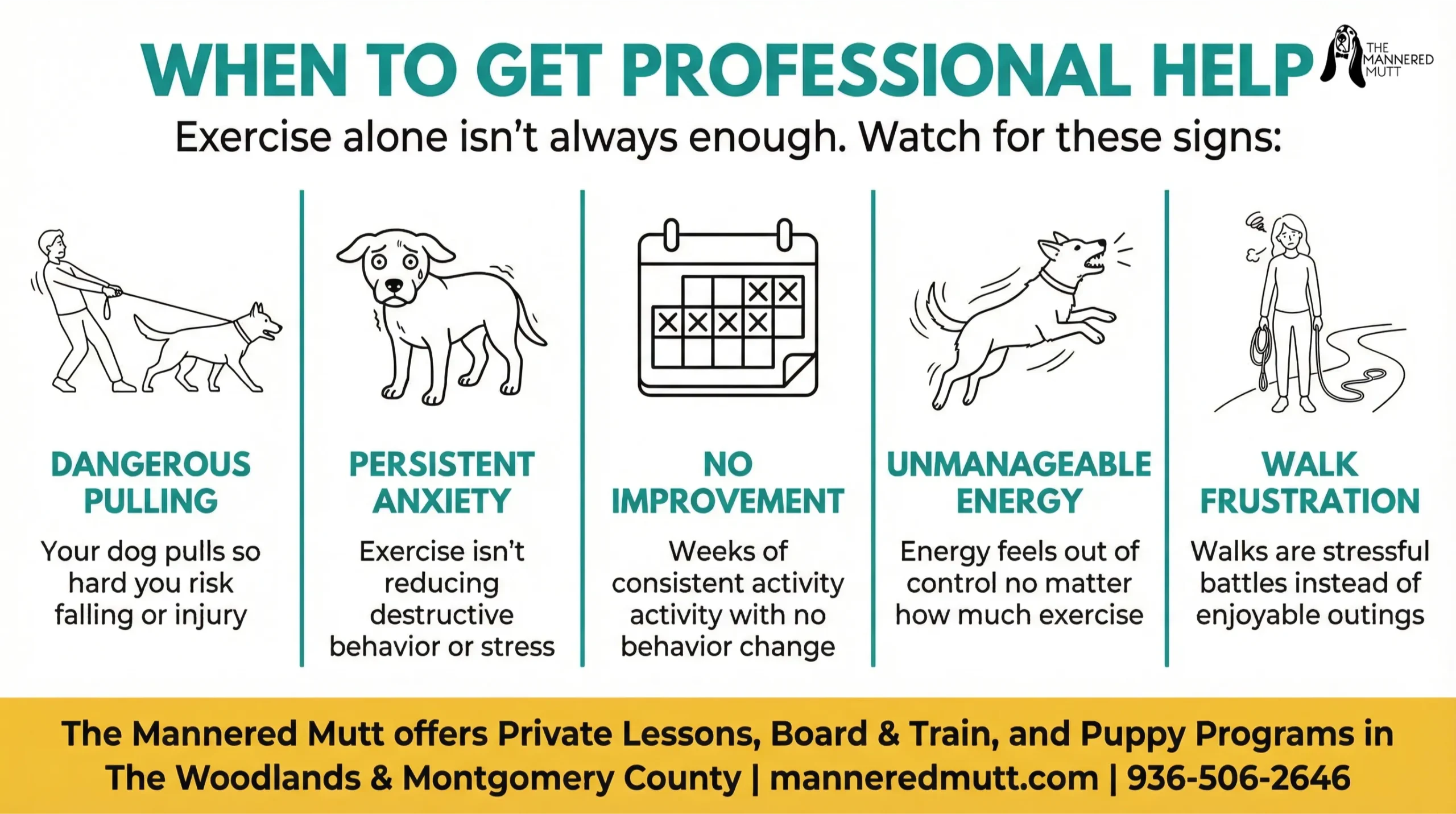
Consider professional dog training when:
- Your dog pulls so hard on walks that you’re at risk of falling.
- Exercise isn’t reducing the anxiety or destructive behavior.
- You’ve tried increasing activity consistently without meaningful improvement.
- Your dog’s energy feels unmanageable regardless of how much exercise they get.
At The Mannered Mutt, Paulina and her team work with dog owners throughout The Woodlands, Conroe, Willis, and surrounding Montgomery County communities. Whether your dog needs foundational obedience through Private Lessons, intensive work through our Board & Train program, or early Puppy Manners, we build every program around your dog’s individual needs.
We also include lifetime maintenance support in our Advanced and Behavior programs, so you’re never left figuring it out alone. Because helping you build a life with your dog that actually works—that’s what we’re here for.
Contact The Mannered Mutt at 936-506-2646 or visit manneredmutt.com to schedule your consultation.
FAQs
Why is my dog so destructive and hyperactive in the evening?
This is a classic sign of pent-up energy. What looks like a “bad dog” is often a bored dog whose physical and mental exercise needs haven’t been met.
How much exercise does my dog really need?
It varies by breed, age, and health, but most adult dogs require 30 minutes to 2 hours of exercise daily. High-energy breeds like shepherds and retrievers need closer to two hours, while smaller or lower-energy breeds might do well with 30-60 minutes.
Are our daily walks enough to tire out my dog?
Not always. A repetitive walk down the same street provides little mental stimulation. To make walks more effective, the article suggests varying your routes, incorporating mini-training sessions (like practicing “sit” at crosswalks), and allowing for structured “sniff breaks” to engage your dog’s brain.
It's too hot/rainy to go outside. What can I do indoors?
Indoor exercise can be very effective. The article recommends activities like playing fetch down a hallway, structured tug-of-war (with rules like “drop it”), using puzzle feeders or sniff mats for mental stimulation, and running short, focused obedience training sessions.
When should I consider professional training instead of just more exercise?
If your dog’s problem behaviors—like severe pulling on the leash, reactivity towards other dogs, or destructive anxiety—don’t improve even after you consistently increase their exercise, it’s a clear sign that professional help is needed. Exercise is foundational, but training provides the structure and communication skills to address the root cause of the behavior.