
Why Does My Dog Jump on Guests? Solutions
You’ve stopped inviting people over. The doorbell rings and you’re already bracing yourself—physically holding your dog’s collar, shouting commands they ignore, apologizing before your guest even makes it through the door. Your 60-pound dog launches at every visitor like they’re the most exciting thing that’s ever happened, and you’ve tried everything: yelling “down,” pushing them off, giving treats to distract them. Nothing works.
Here’s what dog owners in The Woodlands and Conroe need to understand: jumping on guests isn’t a discipline problem you can yell away. It’s an impulse control issue combined with a greeting behavior your dog has been practicing and perfecting every single time someone arrives.
Dog jumping is one of the most frustrating and embarrassing behavior problems The Mannered Mutt addresses with clients throughout Montgomery County. Paulina, our Master Trainer certified since 2012, works regularly with owners whose dogs’ jumping has escalated from annoying to dangerous—knocking over elderly relatives, scratching visitors, making social situations genuinely stressful. The solution isn’t harsher corrections or more restraint. It’s teaching your dog impulse control and training an alternative greeting behavior that gets them what they want (attention) without the chaos.
This guide will help you understand why dogs jump on guests, what’s actually reinforcing this behavior without you realizing it, and proven training techniques that create calm, controlled greetings.
Why Do Dogs Jump on Guests in the First Place?
Understanding the motivation behind jumping is essential for choosing effective solutions. Dogs don’t jump to be defiant or “dominant”—they jump because it works.
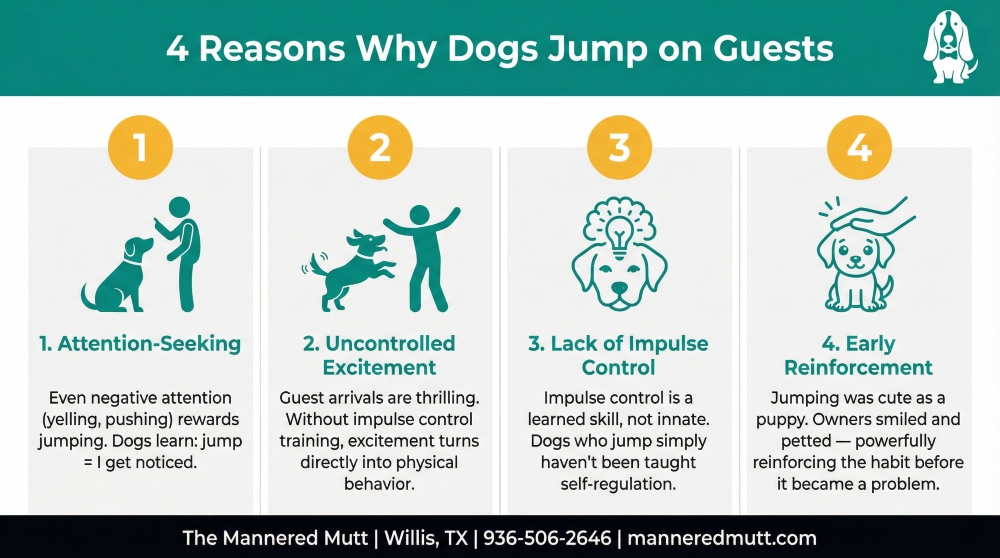
Attention-seeking behavior gets powerfully reinforced. When your dog jumps and you push them off, yell, make eye contact, or physically interact with them in any way, you’ve just given them exactly what they wanted: attention. Even negative attention is attention to a dog. From their perspective, jumping = getting noticed. This inadvertent reinforcement is why jumping often gets worse over time despite owners’ best efforts to stop it.
Excitement during greetings is natural but uncontrolled. Guest arrivals are genuinely exciting for dogs—new person, new smells, change in routine, often accompanied by the owner’s own excitement. For dogs who haven’t been taught impulse control, this arousal has nowhere to go except into physical behavior. Jumping is the outlet for that pent-up excitement.
Lack of impulse control is the root cause. Research on canine impulse control demonstrates that while dogs can improve impulse control through training, many dogs simply haven’t been taught this critical skill. A 2024 study on canine impulse control notes that dogs improve impulse control with specific training experience, emphasizing that impulse control is learned, not innate. Dogs who jump lack the self-regulation to control their bodies when aroused—they feel excitement and immediately act on it.
Early reinforcement patterns matter. Many dogs started jumping as puppies when it was “cute.” Owners smiled, laughed, pet the puppy, or picked them up when they jumped—powerfully reinforcing the behavior. As the dog grew larger and stronger, jumping became problematic, but by then the pattern was deeply ingrained through months or years of reinforcement.
What's Actually Reinforcing Your Dog's Jumping?
Most owners don’t realize they’re actively reinforcing jumping behavior multiple times daily. Identifying these hidden reinforcement patterns is the first step toward change.
Any physical contact reinforces jumping. Pushing your dog off, holding their paws, physically restraining them—all of these involve touching your dog when they jump. Physical contact is a powerful reinforcer. Your dog learns: jump = I get touched/handled by the person I’m excited about.
Eye contact and verbal responses reinforce jumping. Looking at your dog and saying “no,” “down,” “stop,” or any other command while they’re jumping means you’re acknowledging their behavior. Dogs don’t understand the semantic meaning of “no”—they understand that jumping made you look at them and talk to them.
Delayed rewards accidentally reinforce jumping. If your dog jumps, you eventually give up and pet them “to calm them down,” or your guest sits on the couch and then pets your dog, the jumping still worked. The reward came, just delayed. This intermittent reinforcement schedule (sometimes jumping works, sometimes it doesn’t) is actually the strongest type of reinforcement—making jumping extremely persistent.
Environmental rehearsal strengthens the pattern. Every time a guest arrives and your dog jumps (even if no one rewards it), they’re practicing the behavior. Repeated rehearsal without an alternative behavior being taught means jumping becomes your dog’s automatic greeting response.
How Do You Actually Stop Dog Jumping on Guests?
Stopping jumping requires a two-part approach: removing reinforcement for jumping and teaching an incompatible alternative behavior.
Teach an incompatible behavior: the “place” or “sit-stay” greeting. A dog cannot simultaneously sit calmly and jump wildly. Teaching your dog that guest arrivals trigger a specific behavior—going to their place/mat and staying there, or sitting and holding position—gives them something productive to do with their excitement. This becomes the new pattern: doorbell = go to place and wait for permission to greet.
Remove all reinforcement for jumping. When your dog jumps, you become completely uninteresting. No eye contact, no touch, no verbal response, no pushing off. Turn your back, fold your arms, become a statue. The jumping behavior gets absolutely nothing it was seeking. This extinction process requires consistency—if jumping occasionally still works, the behavior persists.
Heavily reinforce the alternative behavior. When your dog chooses to sit instead of jump, or successfully stays on their place mat during arrivals, that behavior gets massively rewarded—treats, calm praise, gentle petting, everything they wanted from jumping. The calm behavior becomes the route to attention.
Research by Davidson and Rosales-Ruiz (2022) on reducing unwanted behaviors through positive reinforcement demonstrated that conditional discrimination training effectively reduced unwanted behaviors like jumping and mouthing when alternative behaviors were reinforced instead.
Practice with staged arrivals. You can’t teach calm greetings effectively if you only practice during actual guest arrivals when everyone’s stressed. Stage practice sessions where family members or cooperative friends repeatedly come to the door, ring the bell, and enter—giving you dozens of repetitions to reinforce calm behavior. This controlled practice builds the skill before testing it in real situations.
| Training Strategy | How It Works | Why It’s Effective | Common Mistakes to Avoid |
|---|---|---|---|
| Teach “Place” Command | Dog goes to mat/bed and stays until released | Incompatible with jumping, gives dog a job | Not practicing enough before real guests arrive |
| Remove All Reinforcement | No touch, eye contact, or verbal response to jumping | Eliminates the reward jumping was getting | Giving in “just this once” when tired |
| Reward Alternative Behavior | Heavily reward sitting, staying on place, four paws on floor | Makes calm behavior more rewarding than jumping | Rewarding too late after dog has already jumped |
| Practice Staged Arrivals | Family members repeatedly practice entrances | Builds muscle memory for calm greetings | Only practicing during real, high-stress arrivals |
| Impulse Control Exercises | Teach “wait,” “stay,” “leave it” in various contexts | Builds general self-regulation skill | Expecting perfection without building foundation |
What Role Does Impulse Control Training Play?
Impulse control—the ability to control one’s behavior despite arousal or temptation—is foundational for solving jumping and numerous other behavior problems.
Impulse control is a learned skill. Dogs aren’t born knowing how to control their impulses when excited. They learn this through specific training that rewards delayed gratification and self-regulation. Teaching impulse control in lower-stakes situations (waiting for food, staying before going through doors, leaving treats alone on command) builds the mental muscle your dog uses during high-arousal greeting situations.
Generalized impulse control transfers to greetings. When your dog has practiced impulse control in multiple contexts—waiting before meals, holding stays despite distractions, controlling themselves around toys—this skill becomes stronger overall. That strengthened impulse control makes it easier for them to control themselves during guest arrivals, even though greetings are highly arousing.
Training builds the capacity for self-regulation. Research on canine impulse control emphasizes that dogs can improve this capacity through training. It’s not about your dog “knowing better”—it’s about building a skill through progressive training that starts easy and gradually increases difficulty.
At The Mannered Mutt, impulse control training is foundational to our Private Lessons and Board & Train programs because it addresses not just jumping but the underlying self-regulation issues that cause numerous behavior problems.
How Does Socialization Affect Greeting Behavior?
Proper socialization during puppyhood and ongoing social experiences significantly impact how dogs greet people.
Well-socialized dogs are calmer around new people. Puppies who are properly exposed to many different people, in many different contexts, during their critical socialization window (8-16 weeks) learn that new people are normal and non-threatening. This early foundation reduces the intense arousal many under-socialized dogs experience when guests arrive. Our Puppy Manners program at The Mannered Mutt specifically addresses this developmental need.
Exposure to calm greeting models helps. Dogs who regularly observe other dogs greeting people calmly (at training classes, during socialization outings, through structured playdates) can learn by watching appropriate behavior. Conversely, dogs who only see other dogs jumping and getting rewarded for it are more likely to adopt that pattern.
Controlled socialization prevents overexcitement patterns. Not all socialization is equal. A puppy who experiences chaotic, overwhelming social situations where jumping and wild behavior go unchecked may actually learn that excitement and jumping are appropriate. Structured socialization where calm behavior is required and rewarded teaches better patterns from the start.
What Training Protocol Actually Works for Calm Greetings?
A systematic training protocol gives you a clear roadmap from current chaos to reliable calm greetings.
Phase 1: Foundation impulse control (Week 1-2). Teach basic impulse control exercises away from greeting situations: wait before meals, sit-stay for increasing durations, leave-it with treats and toys, doorway thresholds where dog waits for permission. Build the foundational skill before applying it to greetings.
Phase 2: Place training without guests (Week 2-3). Teach your dog to go to a specific place (mat or bed) and stay there on command. Practice this throughout the day in various contexts. Build duration—start with 5 seconds, gradually work toward 2-3 minutes. Add distractions—practice while you move around, while you do jumping jacks, while exciting things happen.
Phase 3: Simulated arrivals with family (Week 3-4). Have family members practice coming to the door. Start extremely easy: they come to the door but don’t enter. Gradually increase difficulty: they knock quietly, ring doorbell, open door and enter. Each time, your dog practices going to place and staying there, earning massive rewards for calm behavior.
Phase 4: Cooperative friends as practice guests (Week 4-6). Invite dog-savvy friends who understand they’re helping train, not actually visiting socially. They arrive, your dog goes to place, holds stay. Friend enters calmly, ignores jumping entirely, rewards calm behavior. Repeat with multiple entrances per session. Build up to your dog being released from place to greet calmly.
Phase 5: Real-world implementation (Week 6+). Begin implementing trained greetings with actual guests. Brief them beforehand: no attention if dog jumps, big rewards for calm behavior. Some guests will mess this up—that’s okay, keep practicing. Over time, calm greetings become your dog’s new automatic response.
Research by Pfaller-Sadovsky et al. (2019) on using applied behavior analysis to address jumping demonstrated that understanding the reinforcement contingencies maintaining jumping up and providing noncontingent reinforcement intervention to reduce jumping proved highly effective, supporting systematic training approaches that identify and modify reinforcement patterns.
When Should You Seek Professional Help for Jumping?
Some jumping situations require professional guidance rather than DIY training. Consider professional training when:
- Your dog’s jumping is causing injuries (knocking people over, scratching, jumping at faces)
- You’ve tried training consistently for 6-8 weeks without improvement
- Jumping is accompanied by other concerning behaviors (mouthing, aggression, extreme overarousal)
- You have young children, elderly family, or guests who cannot safely manage a jumping dog
- You’re avoiding having people over because of embarrassment about jumping
At The Mannered Mutt, we address jumping through our Private Lessons program where trainers come to your home and work on greetings in the actual environment where they occur. For dogs with severe impulse control issues beyond just jumping, our Board & Train program provides intensive daily training that builds foundational skills before implementing them at home.
Because jumping is often paired with other impulse control challenges, our training addresses the complete picture—teaching self-regulation that applies to multiple situations, not just guest arrivals.
Contact The Mannered Mutt at 936-506-2646 or visit manneredmutt.com to schedule a consultation. Let’s teach your dog that calm behavior gets them everything jumping never could.
Frequently Asked Questions About Dogs Jumping on Guests
Why does my dog only jump on some people and not others?
Dogs often jump more on people who historically have rewarded the behavior (even unintentionally through attention, touch, or eye contact) or on people who display excitement themselves.
How long does it take to train a dog to stop jumping on guests?
With consistent daily training, most dogs show noticeable improvement in 4-6 weeks, with reliable calm greetings established in 6-8 weeks. However, this timeline depends on how long the dog has been practicing jumping, how consistently training is implemented, and whether everyone in the household maintains the same approach.
Should I use a spray bottle or other correction to stop jumping?
No. Punishment-based corrections like spray bottles don’t address why the dog is jumping (excitement, attention-seeking, lack of impulse control) and often create anxiety or fear without teaching an alternative behavior.
Can I ever let my dog greet guests enthusiastically, or must they always be calm?
Once your dog has learned impulse control and calm greeting as the default, you can add a release cue that allows more enthusiastic (but still four-paws-on-floor) greetings in appropriate situations.
Will socialization classes help reduce my dog's jumping on guests?
Socialization can help if jumping stems from overexcitement about meeting new people due to limited exposure. However, socialization alone won’t fix jumping that’s reinforced by attention-seeking patterns.