
You’ve driven to the dog park three times now, sitting in the parking lot watching other dogs play while yours whines in the backseat. You want to let them run and socialize, but something holds you back—the way your dog lunges at other dogs on leash, or freezes when approached, or completely ignores you when excited. You’ve seen “that dog” at parks before—the one who causes fights, won’t leave other dogs alone, or whose owner chases them around unsuccessfully yelling “come.” You’re terrified your dog will be that dog. Here’s the truth dog owners in The Woodlands and Conroe need to hear: not every dog is ready for the dog park, and taking an unprepared dog can create dangerous situations and traumatic experiences that make behavior problems worse, not better.
Dog parks can be wonderful for the right dogs with the right training. But they’re also high-risk environments where conflicts happen quickly, bad experiences create lasting fear or aggression, and under-trained dogs practice unwanted behaviors hundreds of times. At The Mannered Mutt, Paulina—our Master Trainer certified since 2012—works regularly with clients throughout Montgomery County whose dogs’ behavior problems started or worsened after negative dog park experiences. The good news: with proper training foundations established first, many dogs can enjoy dog parks safely and successfully.
This guide will help you honestly assess whether your dog is ready for the dog park, identify specific skills they need before going, and understand what training prepares them for success.
What Makes Dog Parks Challenging Environments for Untrained Dogs?
Understanding why dog parks are particularly difficult helps explain why training matters so much before visiting.
Completely off-leash with no management. At the dog park, you have zero physical control over your dog. You can’t prevent them from approaching other dogs, stop them from running away, or physically intervene if conflict starts. Everything depends on your dog’s training, impulse control, and responsiveness to verbal commands. If those foundations aren’t solid, you have no way to manage situations.
Unpredictable dogs and owners. You have no control over other dogs’ training, temperament, or vaccination status. You also can’t control whether other owners supervise appropriately, intervene when needed, or even stay off their phones. Your dog might encounter perfectly friendly dogs, aggressive dogs, fearful dogs, or dogs with zero training—all running loose together.
High arousal environment. The combination of multiple dogs running, playing, wrestling, and barking creates intense excitement. This arousal makes it harder for dogs to think clearly, control impulses, or respond to commands. Even well-trained dogs can struggle with self-regulation in this environment, while poorly trained dogs completely lose control.
Conflicts escalate quickly. Research on dog park design and management by Chen et al. (2022) identifies that conflicts between canines occur frequently in these environments, noting the importance of “mitigation of potential conflicts between canines, humans, and the environment.” Without proper training and owner supervision, minor disagreements can escalate to serious fights within seconds.
Bad experiences create lasting problems. A single traumatic incident at the dog park—being attacked, overwhelmed by overly rough play, or terrified by aggressive dogs—can create fear or reactivity that lasts for years. Dogs who weren’t reactive before can become permanently reactive after one bad park experience.
What Are the Warning Signs Your Dog Isn't Ready for the Dog Park?
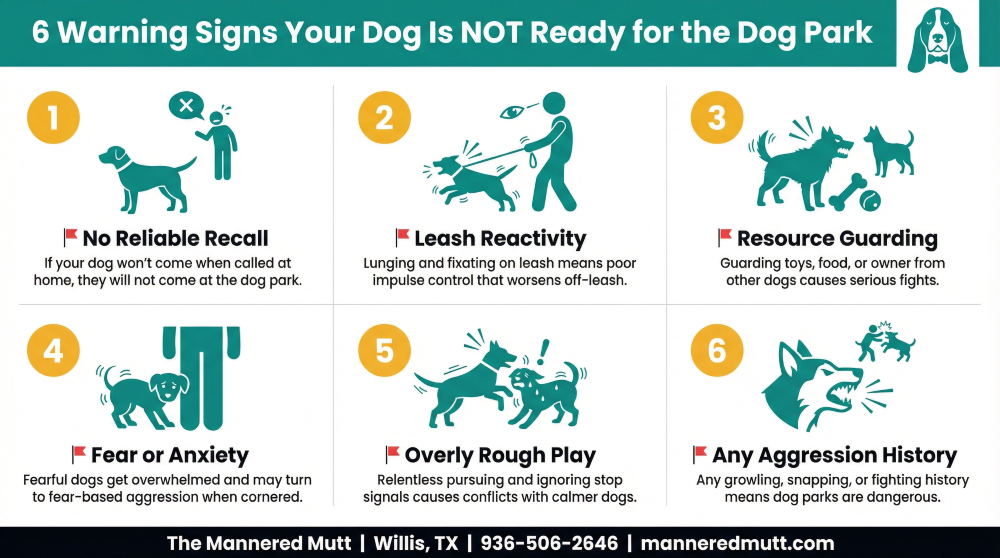
Honest assessment of your dog’s current skills and temperament is essential before attempting dog park visits.
Your dog is NOT ready if they:
- Don’t come reliably when called, even at home or in quiet areas
- Lunge, bark, or fixate on other dogs while on leash
- Guard toys, food, or their owner from other dogs
- Show fear, anxiety, or try to hide when other dogs approach
- Play too rough—body slamming, relentless pursuing, ignoring “stop” signals
- Have any history of growling, snapping, or fighting with other dogs
Poor recall or no recall. If your dog doesn’t reliably come when called in low-distraction environments (your backyard, quiet street), they absolutely won’t come in the high-distraction chaos of a dog park. You need rock-solid recall before going off-leash anywhere, especially dog parks. This is non-negotiable for safety.
Leash reactivity toward other dogs. Dogs who lunge, bark, or fixate on other dogs while on leash are showing you they lack impulse control around other dogs. Off-leash at a dog park, this lack of control manifests as inappropriate rushing, rude greetings, or starting conflicts. Leash reactivity must be addressed through training before dog park visits.
Resource guarding tendencies. Dogs who guard toys, food, or even their owner from other dogs can start serious fights at dog parks where toys and high-value items are present. Any history of resource guarding—growling when another dog approaches their toy, stiffening when another dog comes near their owner—disqualifies a dog from dog parks until this is resolved through behavioral training.
Fear or anxiety around other dogs. Fearful dogs at dog parks get overwhelmed, potentially leading to fear-based aggression when they feel cornered or can’t escape. Dogs who hide behind their owners, tuck their tails, or try to avoid other dogs during controlled on-leash greetings aren’t ready for the intensity of off-leash play with multiple dogs.
Overly rough or rude play style. Some dogs play too intensely—body slamming, mouthing hard, relentlessly pursuing dogs who are trying to disengage. While this might be acceptable with specific dog friends who match their play style, at dog parks it causes conflicts with dogs who have gentler play preferences.
Aggression history of any kind. Any history of dog-dog aggression—growling, snapping, biting, starting fights—means dog parks are inappropriate and dangerous. These dogs need professional behavioral modification, not exposure to uncontrolled dog park environments.
| Readiness Assessment | Ready for Dog Park | NOT Ready – Training Needed First | Red Flags – Professional Help Required |
|---|---|---|---|
| Recall | Comes immediately when called even with distractions | Recall works sometimes or only without distractions | Ignores recall completely when interested in something |
| Greeting Behavior | Approaches calmly, reads other dogs’ signals, disengages when appropriate | Rushes dogs excitedly but not aggressively | Lunges, fixates, stiff body, intense staring |
| Play Style | Adjusts intensity to partner, takes breaks, respects “no” signals | Plays rough but backs off when dog disengages | Relentlessly pursues, ignores stress signals, plays too rough |
| Stress Signals | Recovers quickly from brief stress, seeks owner for check-ins | Shows mild stress but doesn’t escalate | Constant stress signals, tries to escape, shuts down |
| Resource Guarding | Unbothered by other dogs near toys, water, owner | Mild stiffness but no aggression | Growls, snaps, guards toys or owner from other dogs |
| Overall Behavior | Calm, neutral with other dogs, good impulse control | Excitable but manageable, some impulse control | Reactive, fearful, aggressive, or zero impulse control |
What Training Foundations Does Your Dog Need Before Dog Park Visits?
Specific skills must be reliably established before attempting off-leash dog park environments.
Rock-solid recall in high distractions. Your dog must come immediately when called even when playing with another dog, chasing a squirrel, or investigating something exciting. This level of recall requires systematic training that starts in low-distraction environments and gradually increases difficulty. At The Mannered Mutt, our Private Lessons and Board & Train programs build reliable recall through progressive training stages, not just hoping your dog will listen.
Impulse control around other dogs. Your dog needs the ability to control themselves when aroused—approaching other dogs calmly instead of rushing, disengaging from play when asked, and remaining responsive to you despite excitement. This impulse control is built through specific exercises like “wait” at doors, “stay” despite distractions, and controlled greeting protocols with other dogs.
Solid basic obedience. Before going off-leash anywhere, your dog should have reliable responses to sit, down, stay, and leave-it commands in various environments with moderate distractions. These aren’t just tricks—they’re safety tools you’ll need at the dog park.
Proper greeting etiquette. Your dog needs to understand how to greet other dogs politely—approaching at an arc rather than head-on, reading and respecting other dogs’ body language, and disengaging when another dog shows disinterest. This social skill is taught through controlled, supervised dog-dog interactions where inappropriate behavior is redirected before it becomes rehearsed.
Ability to settle and disengage. Dogs who are constantly “on” at the park—running nonstop, unable to calm down, getting increasingly aroused—are headed for conflicts or exhaustion. Training your dog to take breaks, settle when asked, and regulate their arousal level is essential for safe park visits.
How Should You Prepare a Dog for Their First Dog Park Visit?
Even after establishing training foundations, strategic preparation makes first experiences more successful.
Start with controlled socialization first. Before attempting dog parks, arrange playdates with known, friendly, well-trained dogs in fenced yards. These controlled experiences let you observe your dog’s play style and practice recall during play without overwhelming intensity.
Visit during off-peak hours. For initial visits, choose nearly empty times—early morning weekdays. This allows your dog to explore and interact with one or two calm dogs rather than being overwhelmed by a pack.
Keep visits very short. Stay only 10-15 minutes initially. Leave while your dog is still having a positive experience, before overstimulation or fatigue sets in.
Watch body language constantly. Monitor for stress signals—stiff body, tucked tail, whale eye, raised hackles, frozen posture. Intervene immediately by calling your dog away at the first sign of tension.
Be ready to leave. Some dogs aren’t dog park dogs, even with training. If your dog shows fear or starts conflicts, acknowledge dog parks may not be appropriate. Individual playdates, training activities, and long walks provide excellent alternatives.
What Are Safer Alternatives to Dog Parks for Socialization?
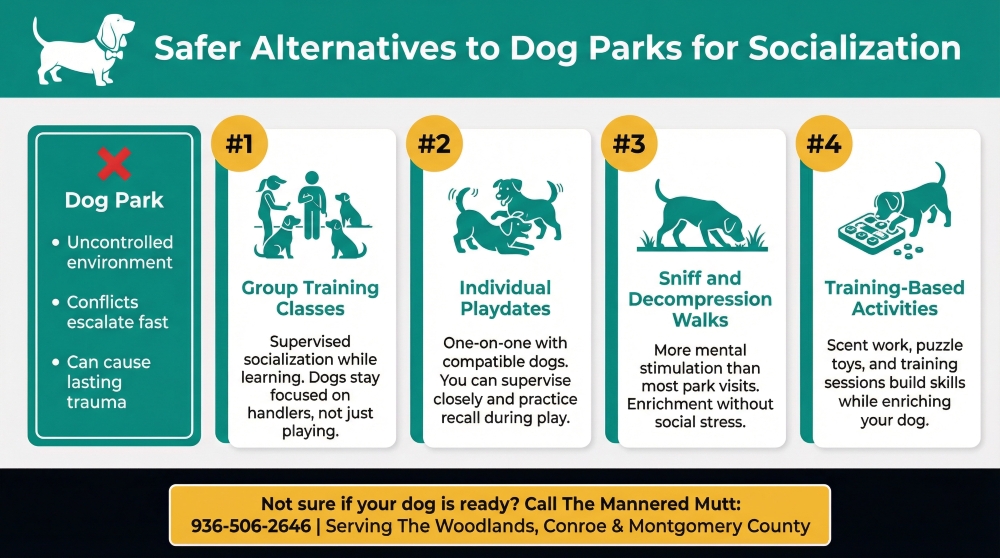
Many dogs benefit more from controlled socialization than free-for-all dog park environments.
Structured group training classes. Classes provide supervised socialization where dogs learn to work calmly around other dogs while focusing on handlers—teaching better skills than unsupervised play.
Individual playdates. One-on-one or small group sessions with compatible dogs create positive experiences without dog park chaos. You can supervise closely and practice recall during play.
Sniff walks and decompression walks. Many dogs get more mental stimulation from long, leisurely sniff walks than dog park visits—enrichment without social stress.
Training-based activities. Engaging your dog’s brain through training, puzzle toys, or scent work often provides better enrichment while building skills.
When Should You Seek Professional Training Before Dog Parks?
Certain situations absolutely require professional training intervention before attempting dog park visits.
Any reactivity or aggression toward other dogs. If your dog shows any signs of reactivity (lunging, barking, fixating) or aggression (growling, snapping, fighting) toward other dogs, professional behavioral training is essential before any off-leash dog interactions. The Mannered Mutt addresses reactivity and aggression through systematic behavior modification.
Poor recall despite your training attempts. If you’ve tried teaching recall but your dog still doesn’t come reliably, professional training can identify what’s missing and build reliable recall through proven protocols. Our Private Lessons program works on recall training in progressively challenging environments, ensuring it works when you actually need it.
Unclear about your dog’s readiness. If you’re genuinely uncertain whether your dog is ready for dog parks, a professional assessment can provide objective evaluation of your dog’s skills and temperament. Paulina can observe your dog’s behavior, identify gaps in training, and recommend whether dog parks are appropriate and what preparation is needed.
Puppy socialization needs. For puppies under 6 months, our Puppy Manners program provides appropriate socialization during critical developmental periods, building positive social skills that create confident, well-adjusted adult dogs who may be good candidates for dog parks later—with proper training.
Research on dog parks as social resources by Vincent (2021) notes they can provide “opportunities for recreation, socialization, and community engagement” for both dogs and owners. But these benefits only materialize when dogs are properly prepared through training. Taking untrained dogs to parks creates stress, conflict, and negative experiences rather than the positive socialization dog parks should provide.
Contact The Mannered Mutt at 936-506-2646 to discuss your dog’s readiness for dog parks and what training will prepare them for success. Whether your dog needs basic obedience, recall training, or behavioral modification for reactivity, we’ll create a training plan that sets them up for positive experiences.
Frequently Asked Questions About Dog Park Challenges
Are small dog parks safer than large ones?
Not necessarily. While smaller parks make it easier to keep an eye on your dog, they also force dogs into closer proximity, which can increase tension and make it harder for dogs to escape situations where they feel overwhelmed.
Should I bring my dog's favorite toys to the park to keep them occupied?
No. Bringing toys to a dog park is a common cause of fights. Even if your dog doesn’t resource guard, another dog at the park might, leading to serious conflicts over a simple tennis ball.
How do I test my dog's recall before going to the park?
Practice on a long lead (20-30 feet) in a semi-distracting environment like a regular park. If they don’t come back to you 100% of the time on the long lead, they are not ready to be completely off-leash.
Does my dog need to know how to "heel" to go to the dog park?
While formal heeling isn’t strictly necessary for off-leash play, your dog must be able to walk calmly on a loose leash from your car to the park gate. A dog dragging you to the entrance is already too aroused to enter safely.
My dog loves running. How can I tire them out without a dog park?
Consider using a long line (15-30 feet) in a large open field (where permitted), playing structured fetch in your yard, trying flirt poles, or exploring dog sports like agility or dock diving.