

Your Border Collie is destroying your apartment while you are at work. Again. Your Husky pulls so hard on walks that you have stopped taking them out. Your German Shepherd’s intensity makes you dread coming home. You are exhausted, you feel guilty, and you are starting to think you made a terrible mistake.
You chose a breed based on how they looked, fond childhood memories, or what seemed popular. Nobody warned you that working breeds actually need jobs. Nobody mentioned that herding dogs will try to herd your children, or that high-energy breeds aren’t exaggerating when they require two or more hours of daily exercise. Now, you are living with a dog whose needs far exceed what your lifestyle can comfortably provide.
The guilt is overwhelming. You love your dog, but you are also exhausted and starting to resent the constant demands. You wonder if you are a bad owner. You wonder if you should rehome them to someone who can give them what they need. You wonder if there is any way to make this work.
Here is what dog owners in The Woodlands, Conroe, and Montgomery County need to understand about breed-lifestyle mismatch. First, you are not alone; this happens frequently. Second, you are not a bad person for struggling. Third, with proper training and management strategies, many mismatched situations can be successfully managed. You may not be able to change your dog’s breed genetics, but you can teach them skills that make those needs manageable within your daily life.
At The Mannered Mutt, Paulina—our Master Trainer certified since 2012—regularly works with clients who are overwhelmed by a breed-lifestyle mismatch. The solution isn’t always rehoming. Often, it is teaching impulse control, providing mental stimulation that substitutes for physical exercise, and building structured routines that work within your actual lifestyle.
This guide will help you understand what went wrong, assess whether training can bridge the gap, and learn practical strategies that make high-needs dogs manageable in real-world situations.
What Are the Most Common Breed-Lifestyle Mismatches?
Understanding common mismatch patterns helps you realize you are not alone and helps identify your specific challenge.
Common mismatches:
- High-energy working breeds in apartments (Border Collies, Australian Shepherds, Belgian Malinois)
- Large guardian breeds with young children (Rottweilers, German Shepherds needing more training than provided)
- Huskies or Malamutes with owners who cannot provide massive exercise
- Herding breeds with owners who cannot manage intense behaviors
- Terriers with owners unprepared for prey drive and independence
- Retrievers or sporting breeds with sedentary owners
The Working Breed in an ApartmentYou brought home a Border Collie, Australian Shepherd, or Belgian Malinois because they are beautiful and highly intelligent. Now they are pacing, destructive, neurotic, and driving you crazy in your 900-square-foot apartment. These breeds were developed to work livestock all day. Without a job, they create their own—usually destructive ones.
The Northern Breed Pulling NightmareHuskies and Malamutes were bred to pull sleds for miles. They pull on a leash with incredible strength, have massive exercise needs, and are often escape artists. If you are not a runner or cannot provide hours of exercise daily, you are facing constant pulling, destruction, and escape attempts.
The Guardian Breed That is “Too Much Dog”German Shepherds, Rottweilers, and Dobermans are powerful, intelligent, and protective. You thought you wanted a guard dog, but you didn’t realize they need extensive training, socialization, and mental work to prevent their protective instincts from becoming problematic aggression or anxiety.
The Herding Breed Managing Your HouseholdAustralian Cattle Dogs, Corgis, and Shelties will try to herd your children, nipping at heels and barking constantly. Herding behaviors that are useful with livestock become highly problematic in family homes when not properly channeled.
Research on companion dog selection criteria (2016) found that many owners do not adequately consider how breed characteristics align with their actual lifestyle before choosing a dog. The mismatch often becomes painfully apparent within the first few months of ownership.
Boruta, A., Kurek, A., & Lewandowska, M. (2016). The criteria for choosing a companion dog. Annals of Warsaw University of Life Sciences, 69, 5-13.
Can Training Actually Fix a Breed-Lifestyle Mismatch?
The honest answer: sometimes training and management can bridge the gap, and sometimes they cannot. Understanding which situation you are in is essential.
When training CAN successfully manage the mismatch:
- Your dog’s needs exceed your lifestyle by a moderate (not extreme) amount.
- You are willing to commit to daily training and structured management.
- The main issues are boredom-driven destruction, pulling, or lack of impulse control.
- You can provide at least baseline exercise, even if it is not the ideal amount.
- Mental stimulation and training can substitute for some physical needs.
When rehoming might be the more humane choice:
- Your dog’s needs so drastically exceed your capacity that they are constantly frustrated.
- Your lifestyle will never allow even baseline exercise (e.g., working 12+ hour days with no time for walks).
- Your dog shows serious aggression that creates safety risks you cannot manage.
- You genuinely resent your dog, and the relationship is damaging to both of you.
- Financial constraints prevent necessary training or veterinary care.
There is no shame in making the difficult decision that rehoming to an appropriate home is best for the dog. A high-drive working dog thriving on a farm is better than that same dog slowly becoming neurotic and destructive in an incompatible home.
Most situations fall in the middle. Training and management can dramatically improve the quality of life for both you and your dog, even if it doesn’t create the “perfect” match. You may never give your Border Collie the ideal working lifestyle, but you can teach them to settle calmly indoors and channel their energy productively.
| Mismatch Type | Can Training Help? | Key Strategies | When to Consider Rehoming |
| High-energy breed, moderate owner | Yes, significantly. | Mental stimulation, impulse control, structured exercise routine. | Only if owner truly cannot provide daily walks or play. |
| Working breed in apartment | Yes, if committed to training. | Mental work, settle training, puzzle toys, training as enrichment. | If dog develops neurotic behaviors despite efforts. |
| Guardian breed, insufficient training | Yes, essential for safety. | Professional behavior modification, socialization, impulse control. | If aggression escalates or creates safety risks. |
| Herding breed with children | Yes, with management. | Redirect herding to appropriate outlets, teach calm behaviors. | If nipping or herding becomes dangerous or unmanageable. |
| Extreme mismatch (e.g., 12+ hour work days) | Unlikely to succeed. | Honest assessment needed. | When the dog’s welfare is genuinely suffering. |
What Training Strategies Help High-Energy Breeds in Limited Spaces?
You cannot change your living situation or add hours to your day. But you can maximize the effectiveness of the time and space you do have.
Mental stimulation exhausts dogs as effectively as physical exercise.Fifteen minutes of focused training work, puzzle-solving, or scent games can tire a dog as much as an hour of fetch. This is critical for high-energy breeds in apartments or with limited exercise time. Use meal times for mental work. Feed kibble through puzzle toys, scatter it for sniffing games, or use it as training rewards instead of feeding from a bowl. Every meal becomes enrichment and brain work.
Teach “settle” and impulse control as foundation skills.High-energy dogs need to learn to be calm indoors. Teaching a “place” command where your dog goes to their bed and stays there creates structured downtime. Impulse control exercises (waiting before going through doors, staying despite distractions, “leave it”) build the capacity for self-regulation. This training doesn’t eliminate the need for exercise, but it creates a dog who can be calm between exercise sessions rather than pacing and whining constantly.
Structure exercise for maximum effect.Thirty minutes of focused, engaging exercise beats two hours of distracted wandering. Use walks for training practice (heel, focus, recall). Add mental challenges to physical activity. Vary routes to provide new smells and experiences. Include short training sessions during walks.
Provide appropriate outlets for breed-specific drives.Herding breeds benefit from herding ball work or treibball. Retrievers need fetching and carrying activities. Terriers love dig pits and tug games. Scent hounds enjoy sniffing games and nose work. Channeling breed drives into appropriate activities prevents them from manifesting in destructive ways.
At The Mannered Mutt, our training programs specifically address high-energy and high-drive dogs. Our Board & Train program provides intensive daily training that teaches impulse control, settling behaviors, and channels energy productively. Our Private Lessons show owners how to maximize limited exercise time and provide mental stimulation that complements physical activity.
How Do You Manage Breed Behaviors That Don’t Fit Your Lifestyle?
Some breed characteristics can be modified through training. Others must be managed because they are hardwired.
You cannot train away breed instincts. You can only redirect them.A Border Collie will always have herding instincts. A Beagle will always want to follow their nose. A terrier will always have prey drive. Training doesn’t eliminate these drives; it teaches dogs when and where to express them appropriately.
Management prevents rehearsal of unwanted behaviors.If your herding breed nips at children’s heels, management means supervising interactions and interrupting before nipping occurs. If your Husky escapes your yard, management means better fencing and not leaving them unsupervised outside. If your terrier kills small animals in your yard, management means supervised outdoor time.
Create routines that work for your actual life.You do not need to become a different person to successfully live with your dog. You need routines that incorporate your dog’s needs into your actual schedule: a morning walk before work, training during dinner prep, an evening play session, and a longer activity on the weekend. Consistency in routine helps high-needs dogs settle into patterns rather than constantly seeking stimulation.
Recognize your limits and work within them.If you can realistically provide 45 minutes of daily exercise, structure that 45 minutes maximally. You cannot pretend you will suddenly become someone who runs 10 miles daily with your dog if you are not a runner. Build management strategies around your real life, not an idealized version.
Research on genetic influences on dog personality (2017) examining Labrador Retrievers found that “genetic influences contribute to personality traits,” demonstrating that breed characteristics are deeply rooted. Training modifies the expression of these traits but does not eliminate genetic predispositions.
What Mental Stimulation Exercises Work Best?
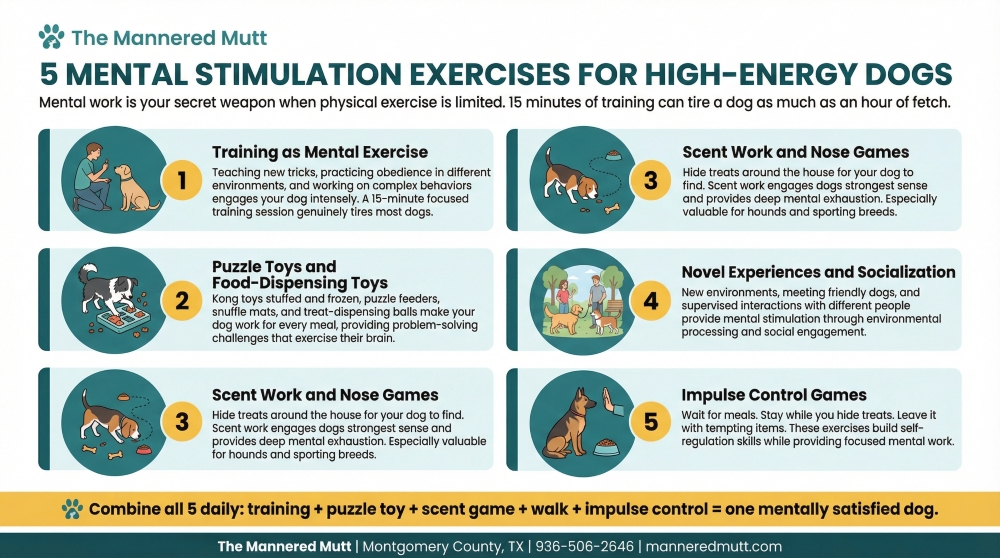
Mental work is your secret weapon when physical exercise is limited. But not all mental stimulation is created equal.
Training as mental exercise: Teaching new tricks, practicing obedience in different environments, and working on complex behaviors engages your dog’s brain intensely. A 15-minute focused training session genuinely tires most dogs.
Puzzle toys and food-dispensing toys: Kong toys stuffed and frozen, puzzle feeders, snuffle mats, and treat-dispensing balls make your dog work for food, providing problem-solving challenges that exercise their brain.
Scent work and nose games: Hide treats around the house for your dog to find. Teach them to search for specific items. Scent work engages dogs’ strongest sense and provides mental exhaustion. It is especially valuable for hounds and sporting breeds.
Novel experiences and socialization: New environments, meeting friendly dogs, and supervised interactions with different people provide mental stimulation through environmental processing and social engagement.
Impulse control games: “Wait” for meals. “Stay” while you hide treats. “Leave it” with tempting items. These exercises build self-regulation skills while providing mental work.
The key is variety and daily consistency. Ten minutes of training, a puzzle toy for breakfast, a scent game in the afternoon, and a structured walk in the evening compound to create a mentally tired, satisfied dog.
When Should You Seek Professional Training Help?
Some breed-lifestyle mismatches require professional guidance to successfully manage.
Seek professional help when:
- Your dog’s destructive behavior is escalating despite your efforts.
- You are considering rehoming and want to explore all options first.
- Your dog shows aggression or reactivity that creates safety concerns.
- You feel completely overwhelmed and do not know where to start.
- Your dog has developed neurotic behaviors (constant pacing, obsessive licking, self-harm).
- Previous training attempts have not improved the situation.
Professional trainers can objectively assess whether training can bridge your specific mismatch, create customized management plans that fit your actual lifestyle, teach you efficient training techniques that maximize limited time, provide accountability and support when you are feeling defeated, and help you make informed decisions about your dog’s future.
The Mannered Mutt specializes in working with challenging, high-drive dogs. Our Behavior Problems program addresses issues that develop from breed-lifestyle mismatch. Our Board & Train program provides intensive training for dogs who need significant behavior modification. Our Private Lessons teach owners effective management strategies.
Contact The Mannered Mutt at 936-506-2646 or visit manneredmutt.com to discuss your situation and explore training solutions.
Ilska, J., Haskell, M. J., Blott, S. C., Sánchez-Molano, E., & Polgar, Z. (2017). Genetic characterization of dog personality traits. Genetics, 206(2), 1101-1111
FAQs
No. Recognizing that you cannot provide what a dog needs and making the difficult decision to find them a better-suited home is responsible, not cruel. However, before making this decision, explore training solutions and management strategies. Many mismatches can be successfully managed with proper help.
This varies by breed, but working breeds typically need 1-2 hours of physical activity daily plus mental stimulation. However, quality matters more than quantity. Thirty minutes of focused, engaging exercise with training beats two hours of mindless wandering.
Yes, usually through a combination of sufficient exercise before you leave, mental stimulation (puzzle toys, frozen Kongs), crate training if appropriate, and teaching settle behaviors. Destruction from boredom or excess energy can be addressed through management and training.
Usually no. Adding a second high-energy dog to a situation you are already struggling to manage doubles the problem; it does not solve it. Your dog doesn’t need another dog. They need appropriate outlets for their energy, mental stimulation, and training. Focus on addressing the current dog’s needs before considering adding another dog.
No. Adult dogs can absolutely learn new behaviors, impulse control, and settle skills. In some ways, adult dogs are easier to train than puppies because they have better focus and impulse control capacity. The “you can’t teach an old dog new tricks” myth is completely false.