
You are in a training class watching a Golden Retriever nail “down” on the third try. The Border Collie next to you learned “stay” in one session. Meanwhile, your dog is on week four and still cannot reliably sit on command. You are starting to wonder if your dog is just not that smart. If you are doing something wrong. If maybe training just will not work for your particular dog.
Here is what dog owners in The Woodlands and Conroe need to understand about learning speed. Your dog is not stupid. You are not failing. Dogs learn at vastly different rates for reasons that have nothing to do with intelligence and everything to do with breed characteristics, individual temperament, motivation levels, and how well the training method matches their learning style.
The Border Collie learning instantly? That breed was literally developed to learn and respond to commands at a distance while working livestock. The Golden Retriever? Bred for generations to be eager to please and responsive to human direction. Your Beagle who seems like they cannot hear you? They were bred to follow their nose independently, ignoring everything else, including you, when they are on a scent trail.
At The Mannered Mutt, Paulina, our Master Trainer certified since 2012, works with dogs throughout Montgomery County who learn at completely different paces. Some master commands in days. Others take weeks. The dogs who take longer are not less intelligent. They just require different approaches, higher-value motivation, or training methods that align with their breed drives and individual personality.
This guide will help you understand why learning speed varies so dramatically between dogs, what factors actually influence how quickly dogs learn, and most importantly, how to adapt your training approach to work with your dog’s natural learning style instead of against it.
What Actually Determines How Fast a Dog Learns?
Multiple factors influence learning speed, and intelligence is only one piece of a complex puzzle. Before you can adapt your approach, it helps to understand the full picture of what is actually at play.
Breed characteristics and genetic predispositions are among the most significant factors. Some breeds were developed for biddability, meaning they naturally want to work with and respond to humans. Others were developed for independence, making them less inclined to follow direction.
Individual temperament and personality also matter enormously. A confident dog tries new behaviors more readily, while an anxious dog may shut down if training feels stressful. A hyperactive dog struggles to focus long enough to learn.
Motivation and what the dog values is another critical variable. If you are using treats and your dog does not care about food, you are working without leverage. If your dog values chasing balls above everything and you are only offering verbal praise, they have no reason to comply with your commands. Beyond motivation, previous learning history plays a role. A dog who has been trained before picks up new commands faster than one who has never been asked to think through a task.
Training method match is something many owners overlook entirely. Whether your approach aligns with your dog’s learning style can make the difference between weeks of frustration and rapid progress. Age and developmental stage also matter. Puppies, adolescents, and adults all learn differently. Environmental distractions determine whether your dog can even process what you are asking. And finally, handler skill and consistency shape every session. Clear, consistent communication produces results. Inconsistent cues produce confusion.
Research on the genetics of canine behavior confirms that breed differences in behavior are significant, with factors such as reactivity, ease of training, and temperament varying substantially by breed. The study found heritability in behaviors including hunting ability, playfulness, and trainability, demonstrating that genetic influences on learning patterns are real and measurable.
How Do Breed Traits Affect Training Speed and Style?
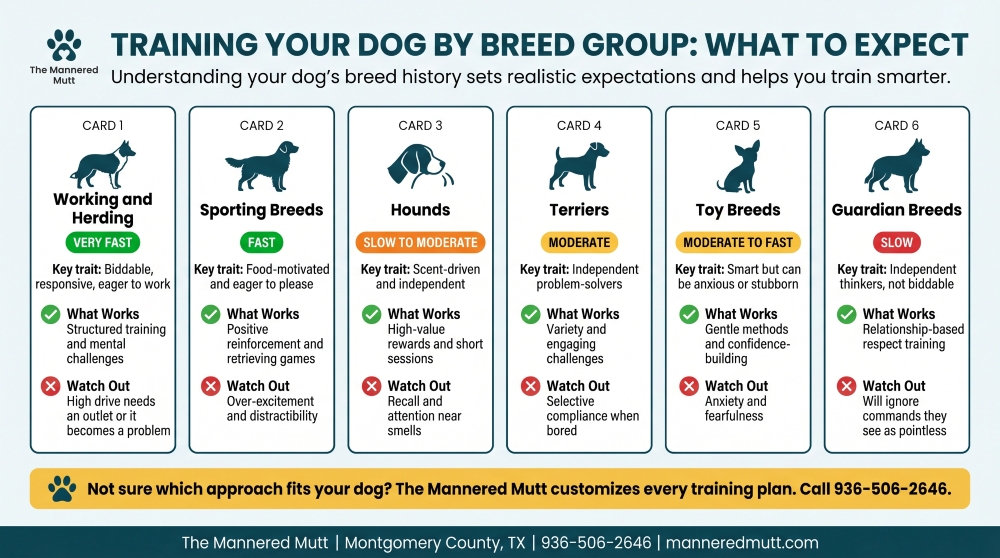
Understanding breed tendencies helps you set realistic expectations and adapt your approach appropriately.
Working and herding breeds often learn commands quickly because they were developed for centuries to take direction from humans. Border Collies, Australian Shepherds, German Shepherds, and Belgian Malinois are biddable breeds, meaning they naturally want to work with you and please you. This does not mean training is easy since their high drive creates other challenges, but command learning happens fast.
Sporting breeds like retrievers are typically eager to please and food-motivated, making them relatively straightforward to train using positive reinforcement. Golden Retrievers, Labrador Retrievers, and Spaniels were bred to work closely with hunters, retrieving game and responding to hand signals.
Hounds follow their noses, not your commands. Beagles, Basset Hounds, and Bloodhounds were developed to track scent trails independently, often while ignoring their handler completely. When their nose is engaged, your voice barely registers. They are not being stubborn. Their genetics are telling them to follow that smell far louder than you are saying “come.”
Terriers were bred to make independent decisions. Jack Russell Terriers, Fox Terriers, and Airedales were developed to hunt vermin underground where humans could not direct them. They had to problem-solve independently and persist despite obstacles. This makes them tenacious, determined, and often less responsive to commands that conflict with what they want to do.
Livestock guardian breeds prioritize independent decision-making over human direction. Great Pyrenees, Anatolian Shepherds, and Maremmas were bred to live with flocks and make protection decisions without human input. Independence is their core function, and training must account for that.
Breed Group | Learning Speed | Training Characteristics | What Works Best | Common Challenge |
Working/Herding (Border Collie, GSD) | Very fast | Eager to learn, responsive, biddable | Structured training, mental challenges, jobs | Managing high drive and intensity |
Sporting (Retrievers, Spaniels) | Fast | Food-motivated, eager to please, responsive | Positive reinforcement, retrieving games | Over-excitement, distractibility |
Hounds (Beagle, Basset, Bloodhound) | Slow to moderate | Scent-driven, independent, selective hearing | High-value rewards, short sessions, scent work | Recall and attention around smells |
Terriers (Jack Russell, Airedale) | Moderate | Independent, determined, problem-solvers | Engaging methods, variety, challenge | Stubbornness, selective compliance |
Toy Breeds (Chihuahua, Yorkie) | Moderate to fast | Smart but can be anxious or stubborn | Gentle methods, patience, confidence-building | Anxiety, fearfulness, small dog syndrome |
Guardians (Great Pyrenees, Akita) | Slow | Independent thinkers, not biddable | Relationship-based, respect over obedience | Will not comply with commands they see as pointless |
This does not mean you cannot train hounds, terriers, or guardian breeds. It means you adjust your expectations, your methods, and your definition of success.
What Is the Difference Between “Won’t Learn” and “Can’t Learn”?
Understanding this distinction prevents massive frustration and helps you address the real issue rather than the wrong one.
“Can’t learn” means the dog genuinely does not understand what you want. Your timing is off. Your cue is not clear. You are asking for something too complex before they have mastered the basics. The environment is too distracting for their current skill level. These are training problems, not dog problems.
“Won’t learn” means the dog understands but lacks motivation to comply. They know what “sit” means. They just do not see any reason to do it. You have not made it worth their while, or what you are offering in terms of praise or treats does not matter to them. This is a motivation problem, not a learning problem.
Environmental factors create “can’t perform” situations that look like “won’t listen.” Your dog sits perfectly at home but ignores you at the dog park. They are not being stubborn. They have not learned to generalize the command to new environments with higher distractions. You have not trained for that level of distraction yet.
Physical or medical issues also affect learning. Painful arthritis makes “down” physically uncomfortable. Hearing loss means they genuinely do not hear quiet commands. Vision problems make hand signals invisible. Thyroid issues affect energy and focus. Before labeling a dog a slow learner, rule out medical causes.
At The Mannered Mutt, we regularly work with dogs whose owners thought they were stubborn or unintelligent when the real issue was pain, unclear communication, insufficient motivation, or training methods that did not match the dog’s learning style.
How Do You Adapt Training for Different Learning Speeds?
Effective training meets your dog where they are instead of forcing them into methods designed for different breeds or personalities.
Increase the value of rewards for harder-to-motivate dogs. If your dog does not care about kibble, use real chicken, cheese, or hot dogs. If they do not care about food at all, use what they do care about, such as balls, tug toys, access to sniffing, or permission to greet other dogs. Find their currency and pay them in it.
Shorten training sessions for easily distracted dogs. Some dogs can focus for 15 to 20 minutes. Others max out at 3 to 5 minutes before their attention wanders. Training in multiple short bursts throughout the day often works better than one long session. Five 3-minute sessions can outperform a single 15-minute session for the right dog.
Reduce distractions for dogs who struggle to focus. Start training in the quietest, most boring environment possible, such as your living room with nothing else happening. Only gradually add distractions as your dog masters commands in easy settings. Expecting a hound to practice recall at a dog park when they can barely do it in your backyard sets both of you up for failure.
Break commands into smaller steps for dogs who need more repetition. Teaching “down” from a standing position might be too big a leap. Teach “down” from sitting first. Then add distance. Then add duration. Then add distractions. Some dogs need the progression broken into very small increments.
Match training style to temperament. Confident, bold dogs can handle more pressure. Anxious, sensitive dogs shut down with any negativity and need pure positive reinforcement. Pushy, independent dogs need consistency and clear boundaries. Eager-to-please dogs respond to praise alone.
What Training Methods Work Best for Slower-Learning Dogs?
Slower-learning dogs are not actually slow. They just need different approaches than the fast-learning Border Collies in your training class.
Capture and mark desired behaviors the instant they happen. The moment your dog offers the behavior you want, mark it with a clicker or a verbal marker like “yes” and reward immediately. Timing is everything. A reward that arrives two seconds late teaches the wrong thing.
Use shaping for complex behaviors. Shaping means rewarding approximations of the final behavior. If you are teaching “down,” reward any movement toward lying down, including lowering their head, bending one elbow, or shifting weight backward. Gradually require closer and closer approximations until they are fully down.
Practice in many different environments to build generalization. Your dog needs to learn that “sit” means the same thing in the living room, kitchen, backyard, front porch, park, and pet store. Each new environment requires practice. This is not the dog being stubborn. This is how learning works.
Keep training upbeat and fun, especially for anxious dogs. If your dog views training as stressful work, they will avoid engaging. Make it a game. Celebrate small wins enthusiastically. End sessions on success even if that success is small.
Build a reinforcement history before adding distractions or difficulty. Your dog needs to successfully perform a command 50 to 100 times in easy settings before you ask them to do it around distractions. Proofing behaviors takes time and systematic progression.
Research on genetic markers predicting dog behavior found that genetic factors influence behavioral responses including trainability in both pedigree and mixed-breed dogs. This supports the reality that some dogs require adapted training approaches due to their genetic predispositions, and that adapting your method is not a sign of failure but a sign of good training.
When Should You Seek Professional Training Help?
Some learning challenges require professional assessment and a customized training plan rather than continued trial and error on your own.
Seek professional help when:
- You have been working on basic commands for months without progress
- Your dog shows fear or anxiety during training sessions
- You are feeling frustrated, defeated, or considering giving up
- Your dog’s behavior is getting worse instead of better
- You cannot figure out what motivates your dog
- You are getting conflicting advice and do not know what to try
- Your dog responds to other trainers but not to you
Professional trainers can objectively assess what is blocking progress, identify whether you are dealing with a “can’t” or “won’t” issue, find what actually motivates your specific dog, demonstrate timing and technique, and create customized training plans that match your dog’s learning style.
The Mannered Mutt works extensively with dogs who learn at different paces. Our training programs adapt to each dog’s breed characteristics, individual temperament, and motivation patterns. Our Board and Train program provides intensive daily training customized to how each dog learns best. Our Private Lessons teach owners how to communicate clearly with their specific dog and find what makes training click.
Some dogs just need different approaches, higher-value rewards, clearer communication, or more patience. Professional guidance helps you discover what your dog needs instead of continuing to struggle with methods that are not working.
Contact The Mannered Mutt at 936-506-2646 or visit manneredmutt.com to discuss your dog’s learning challenges and get expert training support.