facebook_pixel

Is Your Puppy a Destruction Machine? 7 Dog Toys and Strategies to Fix It

Tired of your puppy destroying everything? Learn how to teach appropriate play behaviors and the best do toys to fix it.
Your puppy destroyed another pair of shoes. Yesterday it was the couch cushion. Before that, three “indestructible” toys in a week. Your house looks like a tornado hit it. You cannot leave your puppy unsupervised for five minutes without something getting destroyed. You are starting to wonder if your puppy is just inherently destructive, and if they will ever learn to play without destroying everything they touch.
 
Here is what puppy owners in The Woodlands, Conroe, and Montgomery County need to understand about destructive behavior: Most puppy destruction isn’t actually destructive behavior—it is normal puppy exploration, teething relief, and boredom manifesting as chewing. Puppies do not understand the difference between their toy and your shoe. They don’t know that ripping apart a plush toy is different from ripping apart a couch cushion. They aren’t being bad; they are simply being puppies.
 
But normal does not mean acceptable. You cannot just wait for them to “grow out of it” because, without proper training, destructive puppies become destructive adult dogs. The good news is that you can teach your puppy what is appropriate to play with and how to play without destroying everything. This requires management, redirection, teaching impulse control, and providing appropriate outlets for their natural chewing and play needs.
 
At The Mannered Mutt, Paulina—our Master Trainer certified since 2012—works constantly with puppy owners throughout Montgomery County whose homes are being destroyed. The solution isn’t just buying tougher toys or crating the puppy 24/7. It is teaching appropriate play behaviors, providing adequate mental and physical stimulation, and building impulse control skills.
 
This guide will help you understand why puppies destroy things, distinguish normal exploration from problematic destruction, and teach your puppy to play appropriately without demolishing your house.
 

Why Do Puppies Destroy Everything They Touch?

 
Understanding the reasons behind destructive behavior helps you address it appropriately instead of just getting frustrated.
 
Why puppies destroy:
  • Exploring the world with their mouths = How puppies investigate textures, tastes, and sounds.
  • Teething discomfort (3-6 months) = Chewing relieves painful gums.
  • Boredom and understimulation = Destructive chewing is entertainment when nothing better is available.
  • Excess energy with no outlet = Physical energy manifests as destructive behavior.
  • Lack of impulse control = Young puppies cannot regulate their own behavior.
  • No training on what’s appropriate = Haven’t learned which items are okay to chew.
  • Attention-seeking = Destruction gets an immediate response from you.
  • Separation anxiety = Destruction when left alone stems from panic.
 
Puppies explore everything with their mouths.Unlike humans who primarily use hands and eyes to investigate objects, puppies use their mouths. That shoe isn’t “something to destroy”—it is an interesting object with fascinating texture, smell, and taste. The couch cushion makes interesting sounds when ripped. These are sensory experiences, not malicious destruction.
 
Teething is genuinely painful, and chewing provides relief.Between 3 to 6 months of age, puppies lose their baby teeth and adult teeth emerge. Their gums hurt. Chewing on objects provides counter-pressure that temporarily relieves discomfort. This is why teething puppies chew more intensely during this period.
 
Bored puppies create their own entertainment through destruction.A puppy left alone with nothing to do will find something to do. Destroying a pillow is more interesting than staring at walls. Shredding paper is more engaging than lying quietly. If you don’t provide appropriate mental stimulation and entertainment, your puppy will create their own.
 
Excess physical energy has to go somewhere.A puppy who hasn’t had adequate exercise is a destructive puppy. That energy doesn’t just disappear. It manifests as zoomies, rough play, and destructive chewing. Physical exercise is non-negotiable for managing puppy behavior.
 
Research on educational dog toys emphasizes that existing products often suffer from limited function, poor durability, and lack of user experience focus, noting that effective toys require functionality, shape and color, size adaptability, and material durability to properly engage dogs and prevent destruction from boredom.
 

What is the Difference Between Normal Puppy Play and Destructive Behavior Problems?

 
Not all destruction is created equal. Understanding the difference helps you know when training is working versus when you need professional intervention.
 
Normal puppy destruction looks like:
  • Chewing various objects to explore textures and tastes.
  • Increased destruction during teething (3-6 months).
  • Destruction when bored, understimulated, or lacking exercise.
  • Chewing on inappropriate items because they haven’t learned what is allowed.
  • Destroying things during play (shaking and “killing” toys).
  • Scattered throughout the day, not constant.
  • Stops or redirects when given an appropriate alternative.
 
Concerning destructive behavior looks like:
  • Destructive only when left alone (separation anxiety).
  • Compulsive, repetitive destruction of the same type of item.
  • Destroying things despite adequate exercise, stimulation, and appropriate toys.
  • Aggressive destruction (not playful) with intense fixation.
  • Self-destructive behaviors (chewing paws, tail).
  • Destruction continues past 12-18 months despite training.
  • Ingesting destroyed items regularly (pica).
 
If your puppy’s destruction falls into the “concerning” category, contact The Mannered Mutt’s Behavior Problems program for professional assessment and intervention.
 

How Do You Teach a Puppy What is Appropriate to Play With?

 
Teaching appropriate play requires active training, not just hoping your puppy figures it out.
 
Management prevents rehearsal of unwanted behavior.Puppy-proof your environment. Put shoes in closets. Keep valuables off low surfaces. Use baby gates to restrict access to rooms with destroyable items. Use exercise pens or crates when you cannot actively supervise. Every time your puppy destroys something inappropriate, they are practicing that behavior. Management prevents practice.
 
Provide abundant appropriate chew items.Your puppy WILL chew on things. Give them legal outlets. Have 8-10 appropriate chew items available: rubber toys, rope toys, chew bones, bully sticks, and frozen Kongs. Rotate them to maintain novelty. If you don’t provide appropriate options, they will choose inappropriate ones.
 
Actively redirect from inappropriate to appropriate items.When you catch your puppy chewing something they shouldn’t, don’t just say “no” and take it away. Immediately redirect to an appropriate chew toy. When they chew the toy instead, praise enthusiastically. This teaches them: shoes = boring and get taken away; chew toys = exciting and praised.
 
Make appropriate items more rewarding than inappropriate ones.Stuff Kongs with food. Freeze them for longer-lasting entertainment. Use puzzle toys that dispense treats. Make your puppy’s legal chew toys the most interesting, rewarding items available. An empty rubber toy cannot compete with an interesting-smelling shoe. A frozen Kong stuffed with peanut butter absolutely can.
 
Teach “leave it” and “drop it” commands early.These are essential safety and management commands. “Leave it” prevents your puppy from picking up inappropriate items. “Drop it” gets them to release items they already have. Practice these daily with progressively more tempting items.
Age
Play Training Focus
What to Provide
Common Challenges
8-12 weeks
Exploring everything, learning what is allowed
Variety of textures (rubber, rope, soft toys), frozen teething toys
Everything goes in mouth, no impulse control yet
3-4 months
Peak teething, increased destructive chewing
Durable chew toys, frozen Kongs, bully sticks, safe teething items
Intense chewing, may destroy “indestructible” toys
4-6 months
Building impulse control, learning boundaries
Puzzle toys, interactive toys, variety of chews
Adolescence beginning, testing boundaries
6-9 months
Adolescent energy surge, need for challenge
Advanced puzzle toys, training as mental work, durable toys
High energy, may regress on house manners
9-12 months
Refining appropriate play, adult teeth fully in
Continue variety, maintain training consistency
Settling into adult patterns or bad habits
 
At The Mannered Mutt, our Puppy Manners program specifically teaches appropriate play behaviors, impulse control around tempting items, and “leave it”/”drop it” commands that prevent destruction.
 

How Do You Stop a Puppy from Destroying Their Own Toys Immediately?

 
Some puppies destroy even appropriate toys within minutes. This requires different management.
 
Understand that some destruction of toys is normal play.Many dogs enjoy “killing” their toys—shaking, ripping, and de-stuffing. This is predatory play behavior and completely normal. It doesn’t mean they are destructive; it means they are engaging in natural dog play patterns.
 
Provide destruction-appropriate toys for this play style.If your puppy loves destroying toys, give them toys designed for it. Use plush toys specifically made for destruction (cheap ones you don’t mind replacing), cardboard boxes with treats inside that they can rip apart, or paper bags (supervised) they can shred. Channel the behavior into appropriate outlets.
 
Separate “chew toys” from “destruction toys.”Have durable rubber toys (like Kongs or Nylabones) that are not meant to be destroyed. Teach your puppy to chew these without destroying them. Also, have separate toys specifically for destruction that you expect to be destroyed.
 
Supervise play with destroyable toys.If your puppy tears apart plush toys and eats the stuffing (a choking hazard), they can only have these toys during supervised play. After 10-15 minutes, put them away. This prevents ingestion of dangerous materials while still allowing satisfying destruction play.
 
For aggressive chewers, invest in truly indestructible options.Look for heavy-duty rubber toys designed for power chewers, thick rope toys, and solid rubber balls. Brands like West Paw, Kong Extreme, and Goughnuts are specifically designed for destructive chewers. Yes, they are expensive. But one $20 indestructible toy beats buying ten $5 toys that last a day each.
 

How Much Exercise and Mental Stimulation Prevents Destructive Behavior?

Adequate exercise and mental work are non-negotiable for preventing destruction.
 
Physical exercise baseline for puppies.A general guideline is 5 minutes of structured exercise per month of age, twice daily. So, a 4-month-old puppy needs about 20 minutes of exercise twice a day. This does not include free play or potty breaks—this means walks, fetch, and training sessions. Under-exercised puppies are destructive puppies. That pent-up energy manifests as chewing, digging, and destroying things.
 
Mental stimulation exhausts puppies as effectively as physical exercise.Fifteen minutes of training work or puzzle-solving tires most puppies as much as 30-60 minutes of walking. Use meal times for mental work—feed from puzzle toys, use scatter feeding for sniffing games, or conduct training sessions using kibble as rewards.
 
Structured play sessions prevent destructive play.Don’t just leave your puppy alone with toys and hope they play appropriately. Engage in structured play with them. Play tug games (with rules like “take it” and “drop it”), fetch training, and hide-and-seek. This teaches them how to play WITH you using appropriate items.
 
Create a daily routine that includes exercise, training, and enrichment.
  • Morning walk or play session.
  • Training during breakfast (using kibble).
  • Midday enrichment activity (stuffed Kong, puzzle toy).
  • Afternoon play or walk.
  • Training during dinner.
  • Evening calm-down time.
 
This routine prevents boredom and excess energy that lead to destruction.
 

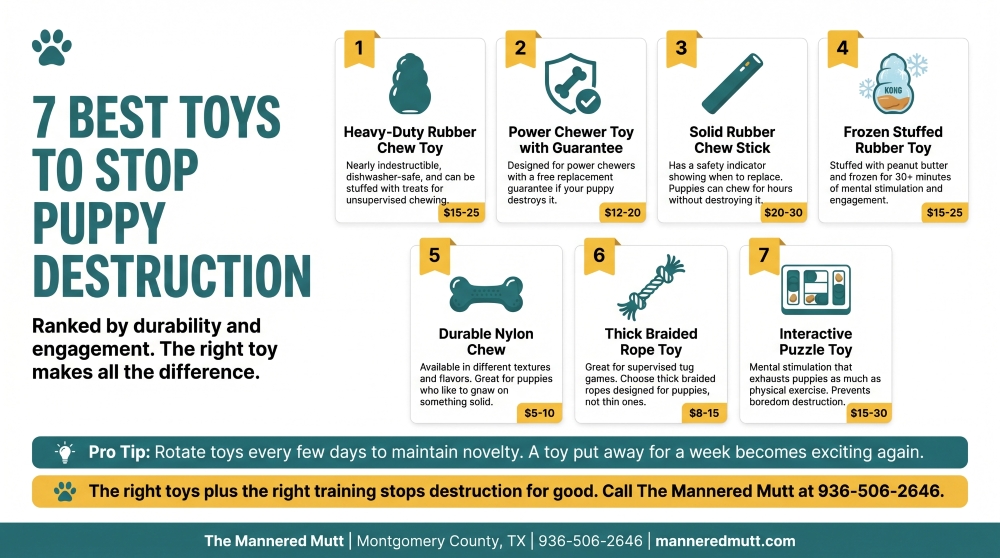
7 Best Toys to Stop Puppy Destruction (Ranked by Durability and Engagement)
infographic_puppy_destroy_toys
Choosing the right toys is crucial for managing destructive behavior. Here are the best options for different types of destructive puppies:
 

1. Heavy-Duty Rubber Chew Toys (Black Rubber)

 
The gold standard for aggressive chewers. Nearly indestructible, dishwasher-safe, and can be stuffed with treats or peanut butter. Puppies cannot destroy them, making them perfect for unsupervised chewing. Cost: $15-25 depending on size.
 

2. Power Chewer Toys with Replacement Guarantee

 
Designed specifically for power chewers with a guarantee—if your puppy destroys it, the manufacturer replaces it free. Available in various shapes and textures. Excellent for puppies who need variety. Cost: $12-20.
 

3. Solid Rubber Chew Sticks

 
A solid rubber chew stick designed for heavy chewers. Has a safety indicator that shows when it needs replacing. Puppies can chew it for hours without destroying it. Cost: $20-30.
 

4. Frozen Rubber Toys Stuffed with Peanut Butter

 
Not just a toy—it is an enrichment activity that provides mental stimulation and keeps puppies occupied for 30+ minutes. Freezing extends the engagement time significantly. Cost: $15-25 for the toy (reusable).
 

5. Durable Nylon Chews

 
Durable nylon chews designed for puppies. Available in different textures and flavors. Good for puppies who like to gnaw on something solid. Cost: $5-10.
 

6. Thick, Braided Rope Toys

 
Great for tug games and interactive play. Choose thick, braided ropes designed for puppies rather than thin ones that can fray. Supervise to prevent ingestion of rope fibers. Cost: $8-15.
 

7. Interactive Puzzle Toys

 
Provide mental stimulation that exhausts puppies as much as physical exercise. Hide treats inside compartments that puppies must figure out how to access. Prevents boredom-related destruction. Cost: $15-30.
 
Pro Tip: Rotate toys every few days to maintain novelty and engagement. A toy that was boring yesterday becomes exciting again after a week of being put away. Look for toys made from durable materials like heavy-duty rubber, nylon, and thick rope designed specifically for puppies.
 

When Should You Seek Professional Help for Destructive Behavior?

 
Most puppy destruction resolves with management, training, and maturity. But some situations require professional intervention.
 
Seek professional help if:
  • Destruction continues or worsens past 12-18 months despite training.
  • The puppy only destroys when you leave (separation anxiety).
  • Destruction is compulsive (same items repeatedly, intense fixation).
  • The puppy ingests destroyed items regularly (pica, a medical issue).
  • Destruction causes injury to the puppy (chewing electrical cords, swallowing objects).
  • You have tried management and training for 2+ months with no improvement.
  • Destruction is so severe you are considering rehoming.
 
Professional trainers can assess whether destruction is normal puppy behavior that needs more time and training, separation anxiety requiring specific protocols, compulsive behavior needing behavior modification, or medical issues requiring veterinary intervention.
 
The Mannered Mutt’s Puppy Manners program addresses destructive chewing through impulse control training, appropriate redirection, and teaching boundaries. For severe cases, our Behavior Problems program provides specialized intervention for separation anxiety or compulsive behaviors.
 
Contact The Mannered Mutt at 936-506-2646 or visit manneredmutt.com to discuss your puppy’s destructive behavior and get expert training support.

FAQs

How long does the destructive puppy phase last?

Most normal destructive chewing peaks during teething (3-6 months) and adolescent energy surges (6-12 months). With consistent training and management, the most intense destruction usually subsides by 12-18 months of age as they mature and learn boundaries.

Furniture provides different textures and resistance than toys, and it smells like you. Puppies chew furniture when they are bored, under-exercised, or haven’t been taught what is appropriate. Redirect them immediately to a highly rewarding chew toy, like a frozen stuffed Kong.

No. Punishment after the fact doesn’t work because puppies cannot connect the punishment to an action they did earlier. If you catch them in the act, simply interrupt the behavior and redirect them to an appropriate toy, then praise them for chewing the right item.

Management is key. Do not leave your puppy loose in the house. Use a properly sized crate or a puppy-proofed exercise pen with safe, engaging chew toys. Ensure they have had adequate physical and mental exercise before you leave.

If your puppy is only destructive when left alone, destroys exit points (doors, windows, crates), vocalizes excessively, or causes self-injury trying to escape, these are signs of separation anxiety rather than normal boredom or teething. This requires professional behavior modification.