

What Does Puppy School Actually Provide?
- Structured socialization with other puppies in controlled environment
- Exposure to various people, sounds, surfaces in safe setting
- Basic obedience foundation (sit, down, come, loose leash)
- Group learning experience where puppies practice around distractions
- Cost-effective option compared to private training
- Set curriculum covering puppy essentials
- Community of other puppy owners for support and questions
- Professional supervision of play and interactions
- Are naturally confident and outgoing
- Enjoy meeting other dogs and people
- Aren’t overwhelmed by noise and chaos
- Recover quickly from startling experiences
- Need structured socialization opportunities
- Have owners who can’t arrange socialization otherwise
- Are fearful, anxious, or shy
- Get overstimulated easily and can’t calm down
- Are reactive or aggressive toward other dogs
- Shut down in chaotic environments
- Need individualized behavior modification
- Have specific problems requiring focused attention
What Does Private At-Home Training Actually Provide?
- One-on-one attention focused entirely on your puppy
- Customized curriculum addressing your specific challenges
- Flexible pacing matching your puppy’s learning speed
- Training in your actual environment where problems occur
- Immediate troubleshooting of technique and timing issues
- Privacy for working on embarrassing or difficult behaviors
- Accommodates fearful/anxious puppies who struggle in groups
- Intensive focus on specific behavior problems
- Are fearful, anxious, or shy
- Have specific behavior problems needing focused attention
- Get overwhelmed in group settings
- Are reactive or aggressive toward other dogs
- Need customized approaches due to trauma or difficult background
- Have owners needing intensive coaching on technique
- Doesn’t automatically provide socialization (you must arrange this separately)
- More expensive than group classes
- Misses community aspect of learning alongside other puppy owners
- Requires more owner initiative to practice skills in distracting environments
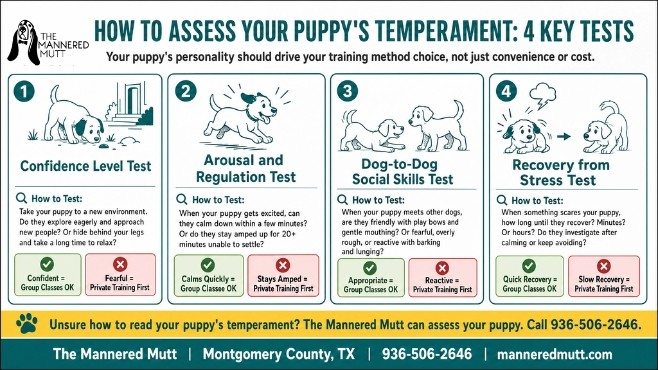
How Do You Assess Your Puppy’s Temperament to Make This Decision
Can You Combine Puppy School and Private Training Effectively?
What Questions Should You Ask Before Choosing a Training Method?
What is my primary training goal right now?
- If socialization is the main need: Lean toward group classes
- If behavior problem-solving is the main need: Lean toward private training
- If both are equally important: Consider combined approach
How does my puppy handle new environments and experiences?
- Confident and adaptable: Group classes likely fine
- Fearful and slow to warm up: Private training probably better initially
- Overstimulated and unable to focus: Private training to build self-regulation first
What specific challenges am I facing?
- Typical puppy issues (housetraining, nipping, basic manners): Either method works
- Specific behavior problems: Private training is superior
What’s my schedule and budget?
- Limited budget: Group classes more cost-effective
- Flexible schedule, higher budget: Private training provides more customization
- Can manage both: Combined approach provides best outcomes
Do I have other ways to socialize my puppy?
- If you have friends with well-socialized adult dogs, puppy playdates, regular outings: Private training can work since socialization is handled separately
- If you lack socialization opportunities: Group classes fill this crucial gap
When Should You Seek Professional Guidance on This Decision?
- Your puppy shows fear or aggression toward other dogs or people
- You’ve tried group classes and your puppy is getting worse, not better
- Your puppy has a traumatic background (rescue, puppy mill, abusive situation)
- You’re seeing concerning behaviors (resource guarding, bite intensity, extreme fear)
- You’re completely overwhelmed and don’t know where to start
- Your puppy has special needs (deaf, blind, physical limitations)
FAQs
What is the ideal age to start training my puppy?
Start between 8-16 weeks during the critical socialization window. Begin housetraining and crate training immediately upon bringing your puppy home. Earlier training is easier because you’re building good habits rather than breaking bad ones. Older puppies can learn too, though they may have more ingrained behaviors to modify. The Mannered Mutt’s Puppy Manners program works with puppies up to 5 months old.
My puppy seemed scared at puppy school. Should I keep going or switch to private training?
If your puppy is gradually warming up each week, continue. But if they’re shutting down (hiding, refusing treats, trying to escape) or getting more fearful, stop. Continuing can damage confidence and create negative associations with other dogs. Switch to private training to build confidence first.
Can I do effective puppy training entirely at home without classes?
Yes, if you arrange socialization separately. Schedule playdates with vaccinated adult dogs, visit various environments (pet stores, cafes, neighborhoods), invite friends over, and expose your puppy to different surfaces and sounds. Private lessons can handle training; you just need to be proactive about socialization.
Is private training worth the extra cost compared to group classes?
For puppies who need it, yes. If your puppy is fearful, aggressive, has specific behavior problems, or isn’t learning in groups, private training provides individualized attention that group classes can’t. You’re paying for customization and faster progress. For confident puppies with no issues, group classes may be sufficient and more cost-effective.
Can I switch from group classes to private training (or vice versa) if my first choice isn't working?
Absolutely. There’s no commitment to one path. If group classes aren’t working after 3-4 weeks, switch to private training. If private training has built confidence and skills, add group classes for socialization. Flexibility based on progress is smart.