
Why Do Dogs Develop Fear of Vet Visits?
Negative Associative Memory
Accumulated Mild Negatives
Handling Sensitivity
Missed Socialization Window
The Compounding Problem
What Is Cooperative Care—And Why Does It Change Everything?
The Core Insight
The Chin Rest: Cooperative Care’s Foundation
At-Home Handling Training: What to Practice and How
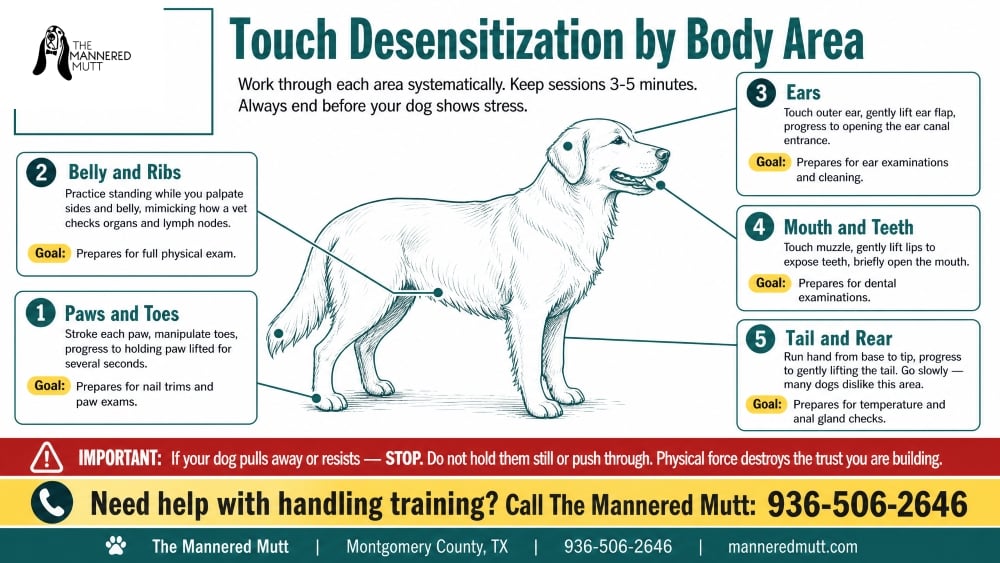
Touch Desensitization by Body Area
- Paws and toes: Gently stroke each paw, then manipulate individual toes. Progress to holding the paw lifted for several seconds. This prepares for nail trims and paw examinations.
- Ears: Touch the outer ear, then gently lift the ear flap. Progress to gently opening the ear canal entrance. Reward every calm moment.
- Mouth and teeth: Touch the muzzle, then gently lift lips to expose teeth. Progress to briefly opening the mouth. This prepares for dental examinations.
- Tail and rear: Run your hand from base to tip, then progress to gently lifting the tail. Many dogs dislike this area—go slowly, reward generously.
- Belly and ribs: Practice having your dog stand while you palpate along their sides and belly, mimicking how a vet checks organs and lymph nodes.
Mock Veterinary Examinations
- Have a family member act as the “vet,” approaching from the front and side, handling your dog while you reward
- Lightly hold a front leg as if preparing for a blood draw, rewarding generously for calm cooperation
- Use a toy stethoscope or blunt object to simulate a stethoscope touch on the chest
- Practice gentle restraint holds—a hand on the shoulder, a gentle hold around the chest—rewarding calm acceptance
Body Area / Procedure | At-Home Practice | Building Progression | When Your Dog Is Ready |
Paws and nail trim | Stroke paws, manipulate toes | Hold paw lifted, tap nails with clipper handle | Paw lifted voluntarily, no pulling away |
Ear examination | Touch outer ear, lift ear flap | Open ear canal entrance gently, brief inspection | Dog holds still with ear lifted for 5+ seconds |
Mouth and dental | Touch muzzle, lift lips | Open mouth briefly, touch teeth | Mouth opens calmly on cue |
Injection sites (shoulder/scruff) | Touch and pinch shoulder area | Pinch and hold 2–3 seconds with reward | Dog holds still for sustained gentle pinch |
Temperature / rear handling | Touch tail base, lift tail | Sustained tail lift with rear area touch | No flinching or pulling away |
Restraint holds | Hand on shoulder while feeding treats | Gradual hold duration increase | Dog remains relaxed during 30-second hold |
Happy Visits: Changing the Clinic Association Directly
When to Seek Professional Training for Vet Anxiety
When anxiety is severe
When you’re unsure how to implement correctly
When sedation has been discussed
Starting with puppies
FAQs
How long does it take to reduce dog vet anxiety through training?
For mild to moderate anxiety with consistent at-home practice, owners typically notice meaningful improvement in 6–12 weeks. Severe or longstanding vet anxiety takes longer—sometimes 3–6 months of consistent work. Progress isn’t always linear; what matters is the trend toward calmer responses over time, not perfection at each visit.
Can I start vet visit training with an adult dog, or is it only for puppies?
It’s never too late. Adult and senior dogs respond well to cooperative care training and desensitization. The process may take slightly longer than with puppies because associations are more established, but behavioral change is absolutely achievable at any age.
My dog is fine at home but panics at the clinic. Why?
The clinic environment itself has become a conditioned fear trigger—your dog has associated the specific smells, sounds, and people of that location with negative experiences. At-home handling practice builds comfort with the physical procedures, but happy visits to the clinic specifically are needed to address the environmental association.
Should I skip vet visits while doing this training to avoid making things worse?
Don’t skip necessary medical care. Instead, talk to your vet about making appointments as low-stress as possible: arriving at quieter times, going directly to an exam room rather than waiting in the lobby, and asking staff to move slowly and use treats during the exam. Some vets are trained in Fear Free handling techniques—asking for this is completely reasonable.
My dog has started snapping at the vet. What do I do?
Snapping is a safety issue that means the anxiety has escalated to the point of defensive aggression. Discuss muzzle conditioning with a professional trainer—a properly introduced muzzle keeps everyone safe while training continues. More importantly, this level of anxiety warrants professional behavioral assessment to design a comprehensive behavior modification protocol before the next appointment.