
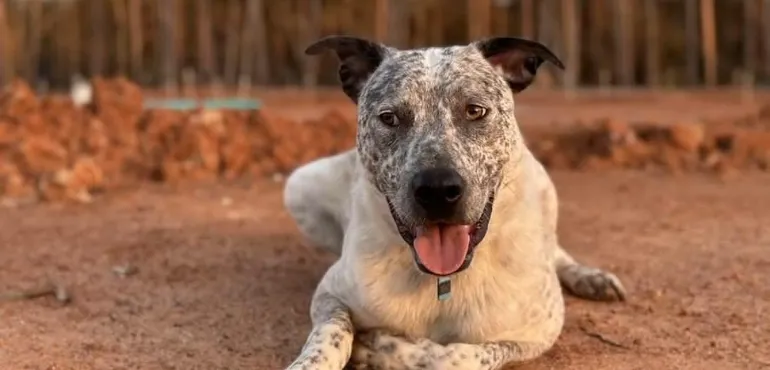
You’ve been standing outside the dog-friendly patio for ten minutes, watching other people enjoy brunch with their dogs lying calmly at their feet. Your dog is pulling toward every passing stranger, barking at other dogs, and making it impossible to even sit down. You finally give up and head home, feeling like you’re the only dog owner in The Woodlands who can’t take their dog anywhere. Here’s what’s important to understand: a calm dog in public isn’t born that way—they’re trained that way, and it starts much earlier than most people realize.
Having a dog who can relax in public places isn’t just convenient—it’s transformative. It means you can include your dog in your daily life instead of leaving them home for every errand, event, and outing. At The Mannered Mutt, we work with frustrated dog owners throughout Montgomery County who want exactly this: a dog they can actually take places and enjoy being around. The path to getting there involves understanding dog socialization, building impulse control, and teaching your dog that calm behavior is what gets rewarded in stimulating environments.
This guide will show you why proper dog socialization training is the foundation for public calmness, what skills your dog actually needs to settle in busy places, and how to teach those skills progressively.
Why Can't Some Dogs Stay Calm in Public Places?
When your dog loses their mind the moment you walk into a pet store or outdoor café, it’s not defiance or bad manners—it’s overwhelm. Dogs who haven’t received adequate dog training and socialization early in life often don’t know how to process busy, stimulating environments.
- Lack of early socialization creates anxious or overexcited responses. Puppy socialization training during the critical 8-16 week window teaches young dogs that new places, people, sounds, and other dogs are normal and non-threatening . Without this foundation, adult dogs often react to novelty with fear (barking, hiding, freezing) or overarousal (pulling, jumping, lunging). This is why puppy socialization classes are so important—they provide controlled exposure to the exact stimuli puppies will encounter throughout their lives.
- Impulse control was never taught. A calm dog in public has learned to control their impulses—to see another dog and choose not to pull toward them, to watch people eating and choose not to beg, to hear exciting sounds and choose to stay in position. These aren’t natural behaviors; they’re learned skills that require specific dog training for socialization in distracting environments.
- Past experiences reinforced the wrong behaviors. If your dog has spent months practicing pulling toward other dogs, barking at strangers, and getting worked up in public, they’ve been rehearsing exactly what you don’t want. Behavior that’s been reinforced for months requires intentional retraining, not just hoping they’ll eventually figure it out.
What Foundation Skills Does Your Dog Need for Public Calmness?
Before your dog can relax at a café, they need specific foundational skills that transfer from low-distraction environments to high-stimulation public places.
The “place” or “settle” command is essential. This teaches your dog to go to a specific spot and remain there calmly until released. In public, this becomes your dog staying on their mat under a table or beside you while you shop. Without this foundation trained at home first, expecting calm behavior in a busy restaurant sets your dog up to fail.
Engagement and focus around distractions. Your dog needs to check in with you even when interesting things are happening around them. This is trained progressively: first in your living room, then your yard, then a calm street, then a moderately busy area, and finally in actual public environments. Socializing dogs effectively means building their ability to focus on you when their environment is exciting.
Calm greetings and neutral responses to other dogs. A dog who lunges or pulls toward every dog they see isn’t ready for public outings. This critical component of dog socialization teaches your dog that not every encounter means playtime.
| Skill | What It Looks Like | Where to Train It First |
|---|---|---|
| Place/Settle | Dog goes to mat and lies down calmly, doesn’t get up without release | Living room, then front porch, then quiet outdoor areas |
| Focus/Engagement | Dog checks in with you regularly, responds to name even with distractions | Home, then yard, then neighborhood walks |
| Neutral Dog Greetings | Dog sees other dogs but doesn’t pull, whine, or fixate | Controlled distance on walks, then closer proximity |
| Impulse Control | Dog can see food/toys/people without lunging or begging | During feeding time, then around dropped food, then in public |
How Do You Teach a Dog to Relax in Public Step-by-Step?
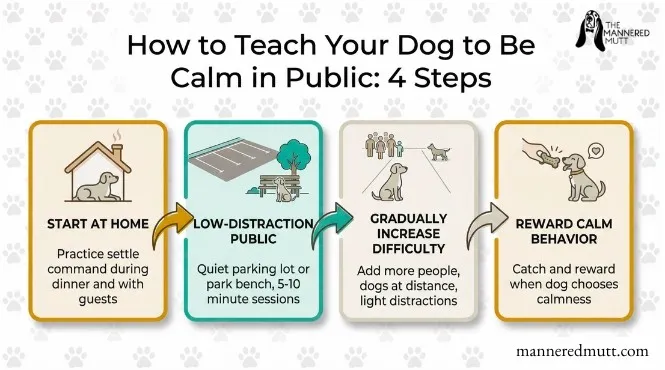
Teaching your dog to be calm in public requires progression from easy to challenging environments. Jumping straight to the hardest scenario guarantees failure.
- Start with the foundation at home. Before entering any public space, your dog should have a solid place command, reliable focus, and basic impulse control at home. Practice having your dog settle on a mat while you eat dinner, while guests visit, and during normal household activity. Reward calm behavior consistently.
- Introduce low-distraction public environments first. A quiet corner of a parking lot or a park bench at an off-peak time—these are stepping stones. Bring your dog’s mat, ask for the settle command, and reward heavily for calm behavior. Keep sessions short (5-10 minutes initially) and end on success.
- Gradually increase difficulty. As your dog succeeds, slowly add challenges: more people nearby, other dogs at a distance, light food smells. If your dog can’t settle, you’ve moved too fast—step back to the last successful level. This patient progression separates effective dog socialization training from rushed approaches that create reactive, anxious dogs.
- Reward calm behavior, not just obedience. Catch and reward moments when your dog chooses calmness on their own—when they lie down without being asked, when they look away from a distraction, when they settle instead of pacing. Some owners find temporary support with calming aids like Adaptil during training, though the primary solution remains consistent behavior work.
What About Socializing Older Dogs Who Missed Early Training?
If you adopted an adult dog or missed the puppy window, you’re not out of options. Socializing older dogs is absolutely possible with the right approach.
- Older dogs can learn new behaviors. While the critical socialization window closes around 16 weeks, adult dogs are still capable of learning public calmness. The process takes longer because you’re undoing established patterns while teaching new responses. Dog socialization classes designed for adult dogs provide controlled environments to practice new skills.
- Fear-based reactivity requires careful handling. If your adult dog is reactive due to fear or anxiety, pushing them into overwhelming situations makes the problem worse. Professional dog socialization training using gradual exposure and positive reinforcement is essential. The Mannered Mutt’s Board & Train program works particularly well for adult dogs because it provides daily, consistent training in controlled environments before progressing to real-world public spaces.
- Consistency matters more with older dogs. Adult dogs who’ve practiced wrong behaviors for years need significantly more repetitions of correct behavior to override old patterns.
How Do Dog Socialization Classes Help Create Calm Public Behavior?
Structured dog socialization classes provide value that solo practice can’t replicate.
- Controlled exposure to triggers. Puppy socialization classes and adult training provide exposure to other dogs, new people, and novel environments in a controlled setting where a professional manages intensity and ensures success. This builds confidence without the risk of your dog getting overwhelmed and rehearsing reactive behavior.
- Professional feedback on your handling. Trainers catch mistakes in real-time—like inadvertently rewarding anxious behavior instead of calm behavior—and help you refine your technique.
- Accountability and structure. Classes provide scheduled training times and homework that keeps you making consistent progress.
At The Mannered Mutt, our programs incorporate dog training and socialization as core components. Whether you’re starting with a young puppy in our Puppy Manners program or addressing established reactivity through Private Lessons or Board & Train, we teach the specific skills your dog needs to be calm in the real world.
What's the Timeline for Teaching Public Calmness?
The timeline depends on your starting point. Puppies with consistent early training typically show calm public behavior within 4-8 weeks. Adult dogs with mild reactivity usually need 6-12 weeks, while dogs with severe reactivity may require 3-6 months of professional intervention.
Working with professional trainers who understand the progression from foundation skills to real-world application accelerates results significantly. This is why The Mannered Mutt includes lifetime maintenance support in our Advanced and Behavior programs.
When Should You Seek Professional Help for Public Behavior Issues?
Some dogs need more than DIY training to become reliably calm in public places.
Consider professional dog socialization training when:
- Your dog’s reactivity in public is getting worse despite your efforts
- You feel unsafe or unable to manage your dog around other dogs or people
- Your dog shows fear-based aggression or severe anxiety in public spaces
- You’ve been practicing for weeks without noticeable improvement
- You want to accelerate progress and avoid common mistakes that set training back
Paulina and the team at The Mannered Mutt work specifically with dogs who struggle in public environments—whether that’s a puppy who needs proper socialization from the start or an adult dog who’s spent years practicing reactivity. We serve The Woodlands, Conroe, Willis, Magnolia, and surrounding Montgomery County communities with programs designed to create genuinely calm, confident dogs you can take anywhere.
Ready to build the calm, public-ready dog you’ve been wanting? Contact The Mannered Mutt at 936-506-2646 or visit manneredmutt.com to schedule your consultation today.
Frequently Asked Questions About Teaching Dogs to Be Calm in Public
How long does it take to teach a dog to be calm in public places?
It depends on age and severity of reactivity. Puppies may show progress in 4–8 weeks. Mildly reactive adult dogs often need 6–12 weeks. More severe cases can take several months of consistent training and professional support.
Can older dogs learn to be calm in public if they missed early socialization?
Yes. Adult dogs can absolutely improve with consistent training and patience. It may take longer to change established habits, but progress is very achievable with the right approach.
What is the most important skill for a calm dog in public?
A solid “place” or “settle” command is foundational. Your dog must first learn to relax on cue at home before being expected to stay calm in busy public spaces.
Should I use calming aids like Adaptil during training?
Calming aids can help reduce anxiety temporarily, but they should support training, not replace it. Long-term calm behavior comes from building confidence through consistent practice.
What is the difference between puppy and adult dog socialization training?
Puppy classes focus on early exposure to prevent fear. Adult training works to modify existing behaviors. Both use structured exposure, but adult dogs usually require more time and repetition.
