facebook_pixel

Beyond Strength: Rottweiler Training for Calm, Confident Obedience

A Rottweiler’s strength is unmistakable, but confidence and self-control are what make life together easier. Learn how early, positive training builds calm Rottweiler obedience, reliable manners, and safer everyday behavior for powerful dogs.
A Rottweiler does not need to prove that they are powerful. Everyone around them can already see it. What they need is a clear, steady training foundation that helps them move through the world with confidence, self-control, and trust in their handler.
 
That distinction matters. The best Rottweiler training is not about overpowering a powerful dog or trying to eliminate the breed’s natural presence. It is about teaching practical skills that allow a large, intelligent dog to make good choices around people, dogs, visitors, and everyday distractions.
 
The . That strength makes early, consistent training especially important, but it does not mean a Rottweiler is destined to be difficult or aggressive. Individual temperament, genetics, health, social experiences, and daily guidance all shape behavior. With thoughtful training, a Rottweiler can become a calm, responsive companion who is a pleasure to live with.
 
At , we help Rottweiler owners in Willis, The Woodlands, Conroe, Magnolia, and Montgomery County build that foundation through clear, individualized training. This guide explains how to develop reliable Rottweiler obedience, encourage confident Rottweiler behavior, and avoid the common mistakes that can make training harder than it needs to be.

Do Rottweilers Need Different Training Than Other Dogs?

Rottweilers do not need harsh training or a separate set of rules. They need the same essentials every dog needs: humane instruction, consistent expectations, sufficient exercise, mental engagement, and carefully paced exposure to the world. What often changes is the importance of getting those fundamentals in place early and practicing them consistently.
 
A fully grown Rottweiler is strong enough that pulling, jumping, rushing a doorway, or ignoring a recall cue can become a real safety issue. Training should therefore focus on life skills that create everyday control without intimidation. This includes a loose leash, a reliable recall, calm greetings, waiting at thresholds, and the ability to settle when excitement is high.
 
The emphasizes that the breed’s size, strength, and protective nature make early training and responsible ownership important. That is a helpful reminder, not a label. A Rottweiler is an individual dog, not a stereotype. Good training should respond to the dog in front of you rather than assuming every Rottweiler will behave the same way.

What Does Confident Rottweiler Behavior Actually Look Like?

Confidence is not barking at strangers, posturing around other dogs, or refusing to listen. A confident dog can notice something unfamiliar without becoming overwhelmed. They can take guidance from their owner, recover quickly from surprises, and disengage when asked.
 
For a Rottweiler, those skills matter in ordinary situations: seeing a delivery driver, meeting a guest, passing another dog on a sidewalk, or settling while the family eats dinner. The goal is not to make your dog overly friendly with everyone. The goal is neutrality and composure.
 
A confident, well-trained Rottweiler typically shows these habits:
  • They can look at a new person or dog, then return their attention to you.
  • They can wait calmly at doors, gates, and vehicles instead of rushing ahead.
  • They can settle on a bed or mat while activity continues around them.
  • They respond to familiar cues even when the environment is more interesting than the living room.
 
These skills are built through repetition and reward. The recommends reward-based methods for all dog training and behavior modification, including behavior concerns. Rewarding the behavior you want creates clarity. It tells your dog exactly what works, instead of merely interrupting what you do not want.

When Should Rottweiler Obedience Training Begin?

Training starts the day your Rottweiler comes home. That does not mean drilling formal commands for long sessions. It means calmly teaching your puppy or adult dog how life works in your home.
 
Begin with simple routines: waiting before meals, coming when called in the house, walking beside you for short distances, resting behind a gate, and allowing gentle handling of paws, ears, and collar. Short sessions are more effective than trying to do too much at once. A few successful minutes repeated throughout the day will build more than one long session that leaves everyone frustrated.
 
For puppies, safe socialization should begin early and should be positive, structured, and appropriate for your puppy’s vaccination status. states that the primary socialization period occurs in the first three months of life and supports safe, well-managed puppy socialization during this period. Socialization is not simply meeting as many dogs and people as possible. It is learning that new experiences can be calm and manageable.
 
For an adult Rottweiler, the same principle applies. Start at a level where your dog can stay relaxed and successful. If your dog is already worried, overexcited, reactive, or fearful, do not force interaction. Create more distance, simplify the environment, and work with a professional who can help you develop a safe plan.

Which Skills Matter Most in Rottweiler Training?

A few practical skills create an enormous difference in daily life with a powerful breed. They are not tricks. They are the foundation of safety, freedom, and trust.
Skill
Why it matters for a Rottweiler
How to build it
Loose-leash walking
Helps prevent pulling, lunging, and loss of control in public
Reward your dog for choosing to stay near you with a loose leash
Recall
Allows you to call your dog away from distractions and back to safety
Practice first in low-distraction spaces, then gradually add challenges
Place or settle
Gives your dog a clear job when guests arrive or household activity increases
Reward calm time on a designated bed or mat
Door and gate manners
Prevents rushing into visitors, dogs, traffic, or open spaces
Teach your dog to pause and wait for permission
Leave it and drop it
Builds impulse control around food, objects, and distractions
Begin with easy trades and reward quick disengagement

Loose-Leash Walking Is a Safety Skill

A Rottweiler that pulls on leash is not necessarily disobedient. Often, they have learned that pulling gets them where they want to go. The answer is not to pull harder. Teach your dog that a loose leash is what moves the walk forward, then reinforce them frequently when they choose the position you want.

Recall Builds Real Freedom

A reliable recall is one of the most valuable skills any large dog can have. Start by making “come” worth your dog’s time. Use a cheerful cue, reward generously, and avoid calling your dog only when something fun is ending. Practice on a long line or in a secure area before expecting reliability around major distractions.

Place Training Creates Calm at Home

“Place” gives your dog a clear alternative behavior when the doorbell rings, food is being prepared, or visitors arrive. Instead of repeatedly telling your Rottweiler “no,” you can direct them to a comfortable spot and reward settled behavior. For many families, this one skill changes the entire atmosphere of the house.
 

How Do You Socialize a Rottweiler Without Creating Overexcitement or Reactivity?

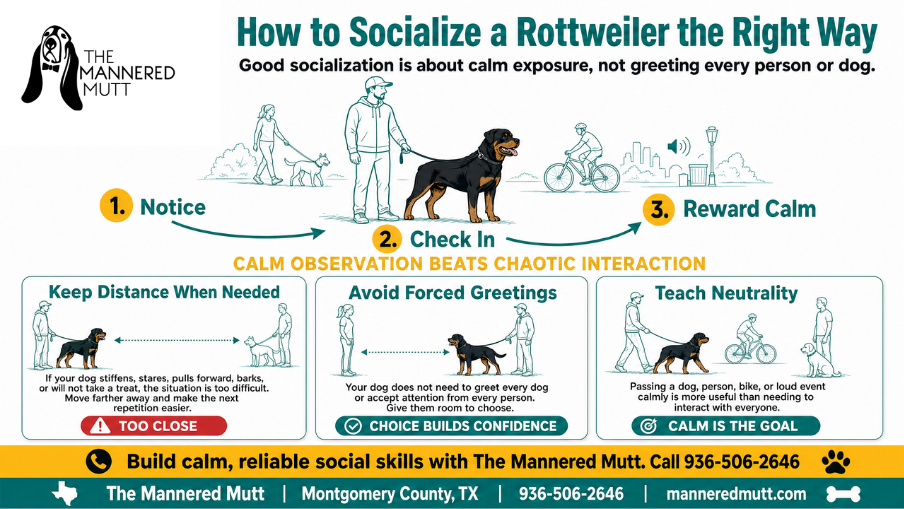
Good socialization is about quality, not quantity. A Rottweiler does not need to greet every dog or accept attention from every person they see. In fact, requiring that level of interaction can create frustration and overarousal.
 
Aim for calm exposure. Let your dog observe people, bikes, other dogs, sounds, surfaces, and new environments from a distance where they can remain relaxed. Reward them for looking, then checking back in with you. Over time, your dog learns that unfamiliar things are normal and that you provide direction.
 
The following approach keeps socialization productive:
  • Keep distance when needed. If your dog stiffens, stares, pulls forward, barks, or cannot take a treat, the situation is too difficult. Move farther away and make the next repetition easier.
  • Avoid forced greetings. Your dog should have room to choose whether to approach. Respecting that choice helps prevent fear-based reactions.
  • Teach neutrality. The ability to pass a dog, person, or loud event calmly is more useful than a desire to interact with everyone.
 
This is especially important for large working breeds. Calm observation and reliable engagement with you will serve your Rottweiler far better than chaotic, uncontrolled interaction.

What Rottweiler Training Mistakes Should You Avoid?

The biggest mistakes are rarely about a missed command. They are usually about inconsistent expectations, rushed exposure, or treating a strong dog like a power struggle.

Waiting Until Your Dog Is “Old Enough” for Training

Waiting allows habits to become stronger. Puppy jumping is easier to manage than adult Rottweiler jumping. Puppy pulling is easier to improve than adult pulling. Start early, and adjust the training difficulty to your dog’s age and physical ability.

Assuming Guarding Behavior Is “Just the Breed”

A watchful dog is not automatically a problem. However, growling over food, guarding a couch, charging the door, or reacting intensely to ordinary visitors should not be dismissed as a normal breed trait. Those behaviors deserve a thoughtful assessment, especially if they are escalating.

Using Fear, Pain, or Intimidation

Trying to “show who is in charge” can damage trust and increase anxiety.  position statement warns against aversive methods and recommends reward-based training for behavior concerns. Strong dogs still learn best when the communication is clear, fair, and consistent.

Practicing Only in the Living Room

A Rottweiler who responds perfectly at home still needs gradual practice around real-life distractions. Build from easy to difficult. A cue learned in the kitchen should later be practiced in the yard, on a quiet sidewalk, and eventually in busier environments as your dog is ready.

How Can You Keep a Rottweiler Mentally and Physically Engaged?

Rottweilers were developed as working dogs, so they benefit from having constructive outlets. Physical exercise matters, but nonstop high-intensity activity is not the only answer. A dog that is physically tired but unable to settle or focus still needs training.
 
Combine age-appropriate exercise with mental work. Short obedience practice, scent games, food puzzles, structured walks, and calm settling exercises all give your dog something productive to do. A well-rounded routine should teach both activity and an off-switch.
 
For adolescent Rottweilers, this balance is particularly important. Adolescence can bring more confidence, more independence, and more testing of boundaries. Keep your rules predictable. Reward good choices often. Do not assume that a behavior is fully trained just because your dog knew it last month.

When Should You Get Professional Help With Rottweiler Behavior?

Professional support is valuable whenever you feel physically overmatched, unclear about your dog’s behavior, or concerned about safety. Do not wait for a serious incident to ask for help.
 
Reach out promptly if your Rottweiler is growling, snapping, biting, guarding resources, reacting strongly to people or dogs, or showing sudden behavior changes. Pain and medical issues can affect behavior, so a veterinary evaluation is also important when changes are sudden or unexplained.
 
At The Mannered Mutt, we begin by looking at the whole picture: your dog’s history, daily environment, triggers, learning style, and the skills you need at home. For many Rottweiler owners, Private Lessons provide the hands-on coaching needed to improve leash handling, home manners, and visitor routines. Our  programs can help build a stronger foundation in commands, distractions, and real-world reliability.

How Does The Mannered Mutt Train Rottweilers in Montgomery County?

A powerful breed does not need a tougher approach. They need a thoughtful one. Paulina has been a Master Trainer since 2012, and The Mannered Mutt’s approach centers on personalized guidance, clear communication, and practical skills that improve life with your dog.
 
We help Rottweiler owners create a plan that fits real life, whether that means calmer greetings at your home in Magnolia, better leash behavior in The Woodlands, or stronger recall and impulse control in Conroe and Willis. Training is not about making your dog smaller, quieter, or less themselves. It is about helping them become safe, confident, and responsive in the situations that matter most.
 
If you are ready to build stronger Rottweiler obedience and more reliable Rottweiler behavior,  with The Mannered Mutt. You can also call  to discuss the best starting point for your dog.

FAQs

Are Rottweilers hard to train?

Rottweilers are intelligent working dogs, but their size and strength make consistency especially important. Clear, reward-based training and regular practice produce the best results.

Start as soon as your dog comes home. Puppies can learn routines, handling, leash basics, and simple cues immediately. Adult dogs can also learn successfully with a plan suited to their current skills.

Teach that a loose leash moves the walk forward and reward your dog for staying near you. Start in a low-distraction setting, then gradually practice in more challenging places.

Do not punish the growl. Create space, prevent forced interaction, and consult a qualified professional. A growl is important communication that should be assessed before it escalates.

Professional training can provide a safer, clearer starting point for strong dogs, especially when you need help with leash handling, guests, recall, or behavior concerns. It also gives you the skills to maintain progress at home.