

Some dogs seem to have a natural way of making people feel better. They sit quietly beside someone who needs company, greet strangers with a wagging tail, or bring a little comfort to an otherwise difficult day. If your dog has that kind of personality, you might have wondered whether they could become a therapy dog.
Therapy dogs visit places such as hospitals, schools, nursing homes, and rehabilitation centers to provide comfort and companionship. But being friendly isn’t the only requirement. A good therapy dog also needs reliable manners, a calm temperament, and the ability to handle unfamiliar people and environments without becoming overwhelmed.
So, could your dog be a good fit? Let’s look at what therapy dog training involves, which skills matter most, and how you can prepare your dog for volunteer visits.
What Is Therapy Dog Training?
Therapy dog training prepares dogs and their handlers to visit facilities where people may benefit from interacting with a calm, friendly animal. These visits can give people opportunities for companionship, positive interaction, and a welcome break from their usual routines.
Unlike dogs trained to assist one person with a disability, therapy dogs work alongside their handlers to interact with different people. Depending on the program, they may visit children at schools, spend time with seniors in assisted living facilities, or participate in organized visits at hospitals and other care settings.
Therapy dog training focuses on more than basic obedience. Your dog needs to respond reliably to cues, greet people politely, remain calm around distractions, and feel comfortable in unfamiliar surroundings. Just as importantly, they should enjoy the experience rather than simply tolerate it.
The American Kennel Club (AKC) provides an overview of the process in its guide to training your dog to become a therapy dog.
Therapy Dogs vs. Service Dogs: What’s the Difference?
Therapy dogs and service dogs can both make a meaningful difference in people’s lives, but they have different roles.
Service dogs are individually trained to perform specific tasks for a person with a disability. These tasks may include guiding someone who is blind, alerting a person to certain medical conditions, or helping someone with a disability perform everyday activities.
Therapy dogs, on the other hand, visit different people as part of an organized program. Their role is to provide comfort and companionship, rather than perform disability-related tasks for one individual.
This distinction also affects where the dogs are allowed to go. Under the Americans with Disabilities Act (ADA), service dogs have specific public-access protections. Therapy dogs do not automatically receive those same rights simply because they have completed training or earned a therapy dog title. Their visits are generally arranged with participating facilities or organizations.
For more details, see the U.S. Department of Justice’s Frequently Asked Questions about Service Animals and the ADA.
What Skills Does a Therapy Dog Need?
A therapy dog doesn’t have to be perfect, but they do need to be reliable, comfortable around people, and able to handle situations that might be unfamiliar or distracting.
Here are some of the most important skills to work on.
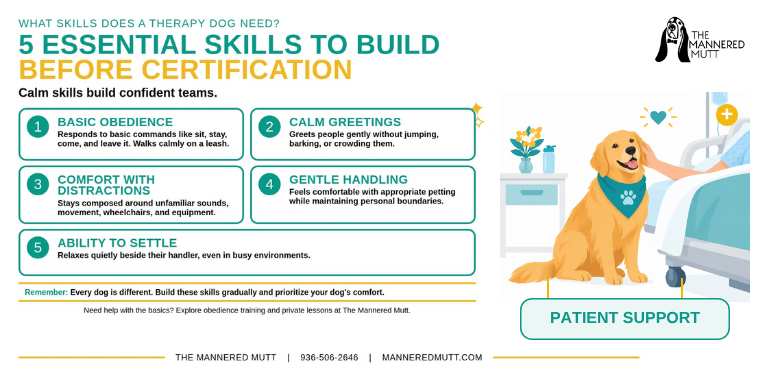
1. Basic Obedience
Your dog should respond consistently to everyday cues such as sit, down, stay, come, and leave it. They should also walk politely on a leash without pulling you toward every person they see.
These skills help you guide your dog through different environments and keep interactions safe and predictable. A dog that responds well at home may still need practice around distractions, so gradually build up to busier settings.
If your dog needs help with these foundations, explore obedience dog training options at The Mannered Mutt.
2. Calm and Polite Greetings
Therapy dogs may meet people who are nervous around dogs, have limited mobility, or aren’t able to respond quickly to an enthusiastic greeting. Jumping, pawing, barking, or crowding someone can make an interaction uncomfortable.
Your dog should be able to approach people gently, keep all four paws on the floor, and settle when asked. They should also be comfortable when people move slowly, speak differently, or need extra time to interact.
Practice greetings with friends and family before moving on to unfamiliar people. Reward calm behavior and give your dog breaks when needed.
3. Comfort Around Unfamiliar Sounds and Movement
Hospitals, schools, and care facilities can be very different from your neighborhood or living room. Your dog may encounter wheelchairs, walkers, medical equipment, unusual noises, busy hallways, or people who move unpredictably.
Gradual exposure can help your dog become more comfortable with different sights and sounds. Start in manageable environments and watch their body language throughout the process.
The goal isn’t to make your dog endure every situation. It’s to help them feel secure enough to participate without showing signs of ongoing stress.
4. Gentle Handling and Social Confidence
During therapy visits, people may want to pet your dog or interact with them in unfamiliar ways. Your dog should be comfortable with appropriate handling and able to remain relaxed when people approach.
However, being a therapy dog doesn’t mean your dog must accept every interaction. Handlers should supervise closely, respect the dog’s boundaries, and prevent people from crowding or overwhelming them.
A good therapy dog can remain calm while still having the freedom to move away or take a break when necessary.
5. The Ability to Settle
Therapy visits aren’t always active. Sometimes your dog may need to sit beside a person, lie quietly near a chair, or wait while you speak with facility staff.
Practice having your dog settle on a mat or beside you for gradually longer periods. Reward relaxed behavior and work toward helping them remain calm even when people are talking or moving around nearby.
How to Prepare Your Dog for Therapy Work
If you’re interested in pursuing therapy dog work, start by building the right foundation rather than rushing straight into an evaluation.
Step 1: Strengthen Everyday Manners
Begin with basic obedience, leash manners, calm greetings, and reliable responses to cues. Your dog should be able to follow your guidance in more than one setting, not just when you’re at home with few distractions.
If you need more individualized support, private dog training lessons can help you work on specific behaviors and challenges.
Step 2: Introduce New Environments Gradually
Give your dog opportunities to experience different people, places, sounds, and surfaces at a comfortable pace. You might practice walking near a quiet public area, visiting a dog-friendly location where permitted, or observing people from a distance.
Keep sessions short enough that your dog can remain relaxed. If they start avoiding people, panting excessively when it’s not hot, repeatedly yawning, freezing, or trying to leave, give them space and reassess the situation.
Step 3: Practice Appropriate Interactions
Arrange calm greetings with people your dog doesn’t know well. Ask your dog to sit or stand quietly, reward them for remaining settled, and end the interaction before they become overwhelmed.
It’s also helpful to practice around people using mobility aids or moving differently, provided you can do so safely and without putting your dog or anyone else in an uncomfortable situation.
Step 4: Research Therapy Dog Organizations
Before committing to a certification route, find out which therapy dog organizations operate in your area and which ones are accepted by the facility where you’d like to volunteer.
Some facilities work with specific organizations, so checking first can save you time. Ask about their evaluation process, training requirements, registration procedures, and any rules for visiting.
The AKC’s guide, Three Steps to Making Your Dog a Therapy Dog, is a useful starting point.
Step 5: Check Your Dog’s Health and Readiness
Your dog should be clean, well-groomed, and healthy enough to participate comfortably. Check the organization’s requirements for veterinary care, vaccinations, parasite prevention, and other health considerations.
You should also consider whether your dog genuinely enjoys meeting people. A dog can be friendly at home but uncomfortable in busy facilities or around unfamiliar people. If your dog shows signs of fear or stress, therapy work may not be the right activity for them, and that’s okay.
Therapy Dog Certification: What to Expect
There isn’t one universal certification that automatically qualifies a dog to visit every facility. Requirements vary by organization, and each program may have its own evaluation, registration, and volunteer procedures.
The process commonly involves demonstrating that your dog has reliable manners, responds appropriately to people, and can remain calm in situations encountered during therapy visits. Some organizations may require supervised visits, a handler orientation, or other preparation before approving a team.
Two organizations worth researching are the American Kennel Club and Alliance of Therapy Dogs.
The AKC Therapy Dog Program
The AKC Therapy Dog Program recognizes dogs and handlers who have completed therapy visits through qualifying organizations. It’s important to understand that the AKC does not itself certify therapy dogs. Certification or registration is handled by qualified therapy dog organizations.
The AKC offers therapy dog titles based on documented visits. Its program includes different recognition levels, from the Novice title for 10 visits to higher titles for teams that complete more visits and meet the program’s other requirements.
These titles recognize volunteer work. They don’t replace the certification or registration requirements of the therapy dog organization.
Alliance of Therapy Dogs
Another option is Alliance of Therapy Dogs, an organization that has its own requirements and evaluation process for therapy dog teams.
Before applying to any program, read its current guidelines and make sure you understand what’s expected of both you and your dog. Requirements can differ, so don’t assume that training or recognition from one organization automatically transfers to another.
Is Your Dog a Good Candidate for Therapy Work?
Many breeds and mixed-breed dogs can become therapy dogs. Breed alone doesn’t determine whether a dog will be suitable. Their temperament, behavior, training, and comfort around unfamiliar people matter much more.
Your dog may be a good candidate if they generally:
-
Enjoy meeting new people without becoming overly excited.
-
Respond reliably to basic obedience cues.
-
Remain calm around unfamiliar sights, sounds, and movement.
-
Accept appropriate handling without showing fear or aggression.
-
Recover reasonably well after an unexpected noise or experience.
-
Can settle quietly beside you when there’s little activity.
-
Appear comfortable and willing to participate in new situations.
On the other hand, a dog that avoids strangers, becomes highly stressed in unfamiliar environments, or reacts strongly to unexpected movement may not enjoy therapy visits. More training can help with some behaviors, but the aim should never be to force a dog into a role that makes them uncomfortable.
It’s also worth remembering that therapy work isn’t the only way for a dog to make a positive difference. If your dog prefers a quieter lifestyle, there are plenty of other ways to enjoy your time together.
Therapy Dog Training in Willis and the Surrounding Areas
If you’re in Willis, The Woodlands, Conroe, or elsewhere in Montgomery County, Texas, The Mannered Mutt can help you work on the everyday obedience and manners that support your dog’s progress.
You can explore obedience dog training services to build a stronger foundation or consider private dog training lessons for more individualized guidance.
Although basic obedience is only one part of preparing for therapy work, it can give you a useful starting point. A trainer can help you identify areas to practice, improve your dog’s responses around distractions, and decide which skills need more attention.
If you have questions about getting started, visit The Mannered Mutt’s For Owners FAQ or contact the team to discuss your dog’s training needs. You can also call 936-506-2646 to ask about available options.
FAQs
Can any dog become a therapy dog?
Many breeds and mixed-breed dogs can be suitable candidates. The most important factors are temperament, reliable manners, and the ability to remain comfortable around unfamiliar people and in new environments. Not every friendly dog will enjoy therapy work, so your dog’s comfort should guide your decision.
Do therapy dogs need certification?
Requirements depend on the organization or facility where you plan to volunteer. Many programs have their own evaluation, registration, or supervised-visit requirements. Check directly with the organization you want to join before beginning the process
How long does therapy dog training take?
It depends on your dog’s current skills, temperament, experience, and the requirements of your chosen organization. A dog with solid obedience and good social confidence may need less preparation than a dog that is still learning to remain calm around distractions. Allow time to build skills gradually.
Can therapy dogs go anywhere service dogs can?
No. Therapy dogs don’t automatically have the public-access rights provided to service dogs under the ADA. Therapy visits are generally arranged through participating facilities or organizations. For details, consult the U.S. Department of Justice’s service animal FAQs.
Where can I find information about therapy dog programs?
Start with the AKC Therapy Dog Program and Alliance of Therapy Dogs. Review each organization’s current requirements to see which program best fits your goals and the facilities where you hope to volunteer.
Therapy dog work can be a rewarding way to share your dog’s friendly nature with people who may appreciate a little extra comfort and companionship. But success isn’t just about having a dog that loves attention. It also means building reliable manners, preparing for unfamiliar environments, and making sure your dog feels safe and comfortable throughout each visit.
Start with the basics, take your time with training, and research the requirements of the organization you want to join. If you need help strengthening your dog’s obedience before taking the next step, explore The Mannered Mutt’s training options or get in touch with the team.
