What to Do After Board and Train: How to Keep Your Dog’s Training on Track

Your dog’s training does not end at pickup. Learn what to do during the first 30 days after board-and-train, how to transfer skills into daily life, and when follow-up support may help.
Your dog is home from board-and-train. Now what? The training does not end at pickup. The first few weeks at home are when you learn how to use the cues, routines, and expectations consistently in your dog’s real environment.
 
It is normal for a dog to behave differently at home than they did with a trainer. Dogs learn in context, so a skill practiced at a training facility still needs to be reinforced around your family, your doors, your yard, your neighborhood, and your everyday distractions. The goal is not perfection on the first day home. The goal is to build clear communication and keep practicing the behaviors that make life easier together.
 

What should you do when your dog first comes home from board-and-train?

Keep the first day calm and simple. Follow the trainer’s instructions, use the same cues and hand signals, and resist the urge to test every behavior at once.
 
Your dog has just experienced a major change. They are leaving a structured training environment and returning to familiar people, smells, routines, and rules. Give them time to settle before inviting visitors, planning a busy outing, or expecting them to handle the hardest situation they faced before training.
 
Start by reviewing the handoff information. Make sure every adult in the household understands:
  • Which words or signals the dog has learned
  • What each cue means
  • What behavior you should reward
  • Which situations still need more practice
  • What equipment, schedule, and routines the trainer recommends
  • What to do if the dog becomes confused or overwhelmed
 
If you are unsure about a cue, ask for a demonstration. It is much easier to build a consistent habit when everyone understands the plan from the beginning.
 

Why Might your Dog Act Differently at Home?
A change in behavior at home does not automatically mean the training failed. The environment has changed, and your dog needs to learn that the same expectations apply in this new setting.
 
The training facility may have fewer household distractions, different doorways, different smells, and a different daily rhythm. At home, your dog may need to respond while children move through the room, food is being prepared, another pet is nearby, or someone is standing at the front door.
 
The explains that dogs do not automatically generalize a behavior from one setting to another. A dog may learn to wait at one doorway but still need practice at the door they use every day. Continued reinforcement and practice help the behavior carry over to new places.
 
Think of the first weeks at home as a transfer period. You are not starting from zero. You are helping your dog understand how the new skills fit into your family’s normal life.
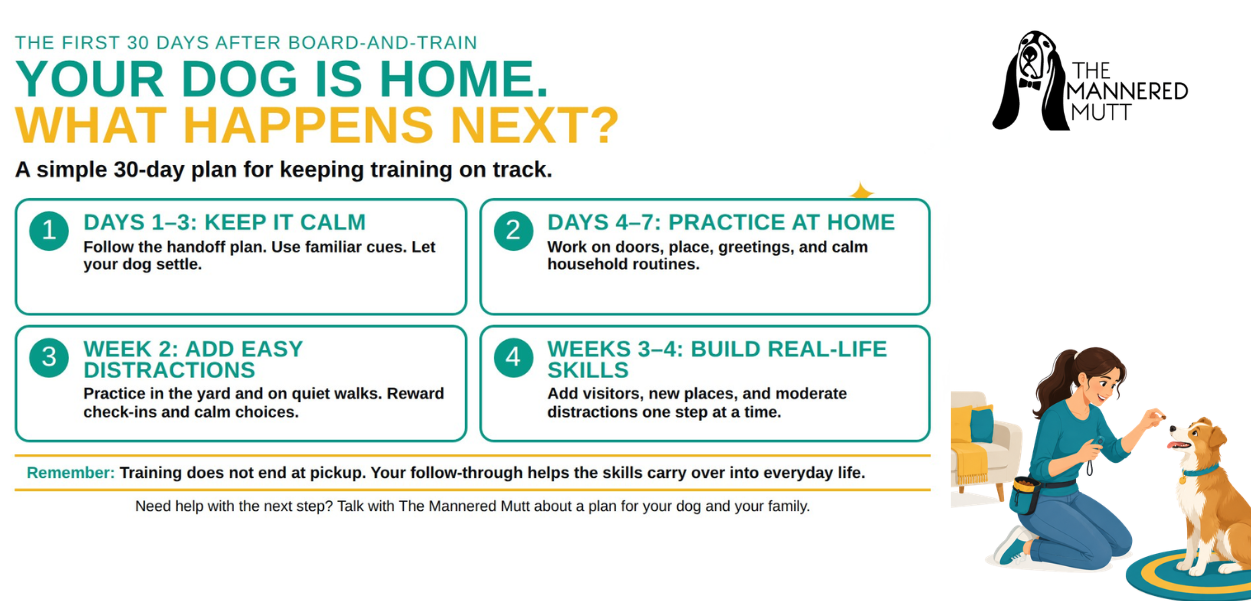
infographics about the first 30 days after board and train
 
 
Use short, successful sessions and add difficulty gradually. If your dog cannot respond, make the situation easier instead of repeating the cue louder or asking for more than they can handle.
 

Days 1–3: Reconnect and simplify

Keep the household routine predictable. Practice familiar cues in quiet parts of the home, reward calm behavior, and give your dog appropriate opportunities to rest.
 
Avoid turning the first evening into a performance test. You do not need to call your dog away from every interesting smell, invite a crowd over, or visit the busiest place in town. Calm, clear practice is more useful than a long session filled with frustration.
 

Days 4–7: Add everyday household routines

Once your dog is settling back in, practice the behaviors that matter around the house. These may include waiting at doors, going to a place, staying settled while the family eats, and responding when called from one room to another.
 
Choose one or two priorities at a time. If jumping on visitors was a problem, work on calm greetings before expecting your dog to remain composed during a large gathering. If door dashing was the concern, practice at a quiet interior door before adding an open front door and an arriving guest.
 

Week 2: Move practice into the yard and neighborhood

Take the skills outside when your dog can respond in easier settings. Begin in the yard or another quiet area, then practice on short walks with manageable distractions.
 
Reward check-ins, loose-leash walking, waiting, and coming when called. Keep your dog at a distance from distractions where they can still think and respond. If they are pulling, barking, freezing, or ignoring every cue, the situation may be too difficult right now.

Weeks 3–4: Build real-life reliability

Now you can begin adding the situations that caused the original frustration. Practice around visitors, moderate outdoor activity, other dogs at a safe distance, or new locations, depending on your dog’s needs.
 
Change only one part of the picture at a time. You might increase the distance from you, add a mild distraction, or practice in a new location, but not all three at once. End while your dog is still able to succeed.
 

What Mistakes can Cause Training to Fade?

Training often becomes confusing when the rules change from one person or situation to the next. Your dog needs clear information about which behaviors work, not a different set of expectations from every member of the family.
 
Common problems include:
  • Repeating a cue several times without helping the dog respond
  • Allowing a behavior one day and correcting it the next
  • Stopping reinforcement as soon as the dog performs the skill once
  • Practicing only in a quiet room
  • Increasing distractions too quickly
  • Expecting reliable off-leash behavior before recall is ready
  • Assuming the dog will remember a skill without regular practice
 
Maintenance does not need to take hours. A few short practice opportunities during normal routines can be more useful than one exhausting session each week. Reward your dog when they choose the behavior you want, such as settling beside you, checking in on a walk, or waiting at a doorway.
 
The also notes that owners may need to adjust parts of the home routine that contribute to unwanted behavior. If food is always left within reach, for example, the dog continues to receive opportunities to practice taking it. Training works best when the household setup supports the behavior you are trying to build.
 

Does Board-and-Train Replace Owner Training?

No. Board-and-train can provide structured practice and help establish new skills, but owners still need to learn the cues, reinforce desired behavior, and apply the plan at home.
 
You are the person who will use these skills every day. Your dog needs to understand that the same communication works with you, in your house, on your walks, and around the situations that matter to your family.
 
This is also why the handoff matters so much. Ask questions, practice in front of the trainer, and write down anything you may forget. Training should help you feel more confident, not leave you wondering what to do after your dog comes home.
 

When Should you Contact the Trainer Again?

Contact the trainer when you need help transferring a skill to your home, when different family members are getting different responses, or when a behavior returns in a new setting. Follow-up support can help you identify whether the problem is the cue, the environment, the timing of the reward, or the level of difficulty.
 
Do not keep pushing through a situation that creates fear or a serious safety concern. If your dog begins showing sudden aggression, unusual sensitivity to touch, reluctance to move, major changes in appetite or sleep, or other abrupt changes, contact your veterinarian. Pain and illness can affect behavior, and recommends documenting changes and discussing them with a veterinarian.
 
If your dog has a bite history, severe aggression, intense fear, or significant distress, use management to prevent unsafe interactions and seek qualified professional guidance. Do not punish, corner, or force your dog through an overwhelming situation.
 

How can The Mannered Mutt help after board-and-train?

The Mannered Mutt works with dog owners in Conroe, Willis, The Woodlands, Montgomery County, and nearby communities. Its current Board & Train program describes customized training for dogs who need more structured support, and its website also provides and for continued skill-building.
 
The right next step depends on your dog, your household, and the behaviors you want to improve. If you are preparing for board-and-train or need help after your dog comes home, to discuss your situation and the support that may fit your family.

FAQs

How long does it take for a dog to adjust after board-and-train?

Some dogs settle back into the home routine quickly, while others need more time and simpler practice. Follow the trainer’s instructions and increase distractions gradually instead of expecting an exact timeline.

Your dog may have learned the skill in a different context and may not yet understand that the same expectation applies with you. Practice the cue in easy settings, reward the response, and ask the trainer to coach your handling if needed.

Use the rewards recommended in your training plan and reinforce the behaviors you want to see continue. As the behavior becomes reliable, your trainer can help you adjust the type and frequency of rewards without removing reinforcement too quickly.

A behavior returning in a new setting does not automatically mean the program failed, but it does mean the plan may need adjustment. Lower the difficulty, prevent unsafe rehearsal, and contact the trainer for guidance.

No, follow-up helps the dog and owner use the skills across the places and routines of everyday life. Continued practice is a normal part of maintaining behavior, especially when the home environment is different from the training environment.

A successful board-and-train transition is built through clear communication, realistic expectations, and regular practice at home. Keep the first days calm, use the same cues, reinforce the behaviors you want, and add distractions gradually.
 
Your dog is not expected to return home knowing how to handle every possible situation perfectly. With patience and consistent follow-through, you can help the training become part of your everyday life. If you need help deciding what to practice next, The Mannered Mutt can help you talk through a plan for your dog and your family.