Dog training conversations often use familiar words in very different ways. One person says a treat is a bribe. Another calls it a reward. A trainer may talk about reinforcement, luring, management, or punishment, while a dog owner is simply trying to teach a reliable sit, calmer greetings, or a safer walk.
This dog training terms explained guide separates the everyday meanings from the technical ones. Understanding the difference between reward and reinforcement, lure and bribe, and management and training can make it easier to evaluate advice and choose a plan that fits your dog and your family.
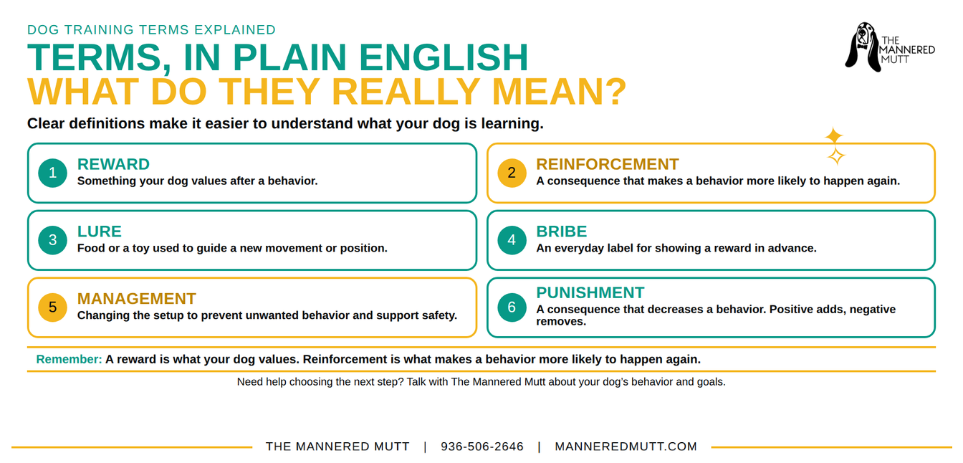
Dog Training Terms at a Glance
These terms describe different parts of a training plan. The detailed explanations below show why timing, context, and the dog’s future behavior matter more than labels alone.
Is a Dog Treat a Bribe?
Usually, a treat is a reward when it is delivered after a behavior to encourage that behavior in the future. It may be described as a bribe when the dog is shown the treat first and appears to respond only when the food is visible, but the context and timing matter more than the label.
For example, if you ask your dog to sit, your dog sits, and you then deliver a treat, the food is functioning as a consequence of sitting. If you hold food in front of your dog’s nose to help guide them into a sit, the food is functioning as a lure. Both can be part of a learning plan.
The word “bribe” is often used to express frustration with food in training. It can make owners worry that their dog will never listen without seeing a treat. A better question is: What behavior is being taught, what information is the dog receiving, and how will the prompt or reward be adjusted as the behavior becomes clearer?
What is a Reward in Dog Training?
A reward is something the dog values and receives because of a behavior you want to encourage. Food, play, access to sniffing, praise, attention, and moving forward on a walk can all be rewards, depending on the individual dog and the situation.
A reward is not automatically rewarding just because a person chose it. Kibble may be useful in a quiet room but uninteresting beside a squirrel. Praise may matter greatly to one dog and very little to another. The reward needs to have value for that dog at that moment.
Rewards also need to match the difficulty of the behavior. A small food reward may be enough for a familiar sit indoors. A more valuable reward, more distance from a distraction, or a chance to return to an appropriate activity may be needed when the dog is learning around visitors, other dogs, or outdoor movement.
Rewards are not limited to food. If your dog walks with a loose leash and then gets permission to sniff, the sniffing opportunity may function as a reward. If your dog checks in with you and then gets to continue walking, moving forward may reinforce the check-in.
What is Reinforcement?
Reinforcement is the process by which a consequence makes a behavior more likely to happen again. The important part is the change in future behavior. If the behavior becomes more likely, it was reinforced. If it does not change, the consequence may not have been reinforcing for that dog in that situation.
This is why reward and reinforcement are related but not identical. A reward is something offered or delivered. Reinforcement describes what that consequence does to behavior.
For example, you give your dog a piece of chicken after a recall. If your dog begins turning toward you more often when called, the chicken reinforced the recall behavior. If your dog ignores the chicken, the environment may be too difficult, the reward may not matter enough, or the timing may not clearly connect the food to the response.
The American Veterinary Society of Animal Behavior’s glossary explains that behavior is reinforced when it becomes more likely to be repeated. It also describes reward-based training as giving rewards for behaviors you want to encourage and arranging the environment so the dog is more likely to perform those behaviors. What Do Positive and Negative mean in Reinforcement Terminology?
In behavior terminology, “positive” means something is added and “negative” means something is removed. These words do not mean good and bad.
Positive reinforcement means adding something the dog values after a behavior, such as giving a treat after a sit. Negative reinforcement means removing or reducing something unpleasant after a behavior, which is a different process from positive reinforcement.
Negative punishment means removing something the dog wants to reduce a behavior, such as briefly ending attention after jumping. Positive punishment means adding something unpleasant to reduce a behavior.
These terms describe how consequences work, not a complete training plan. The AVSAB position on humane dog training recommends reward-based methods and advises against aversive methods. That is a professional organization’s position, not a statement that every business uses the same tools or methods. What is a Lure in Dog Training?
A lure is food, a toy, or another object used to guide a dog into a position or movement. The American Veterinary Society of Animal Behavior defines luring as using food or a toy to guide the dog into a position, such as moving food above the dog’s nose to encourage a sit.
A lure can help a dog discover a new behavior before the behavior has a reliable verbal cue. For example, you might move a treat from your dog’s nose toward your shoulder, and as your dog follows it, their bottom lowers to the floor. You can then mark and reward the completed sit.
The goal is not for the dog to follow a treat forever. Once the dog understands the movement, the visible food can be reduced, the hand motion can become smaller, and the verbal cue can be added before the behavior. The reward can then be delivered after the response rather than shown as a constant prompt.
A lure is an instructional tool. It helps create the behavior. A reward is delivered because the behavior happened and helps make that behavior worth repeating. The same piece of food can be used first as a lure and later as a reward, depending on when and how it is presented.
What is the Difference Between a Lure and a Bribe?
A lure guides the dog toward a behavior while the behavior is being taught. A bribe is an everyday label for showing a reward in advance to persuade the dog to perform a behavior they already know, often without a plan to fade the visible prompt.
The distinction is not always absolute. Owners may use “bribe” to describe any visible food, even when they are teaching a new movement. Rather than arguing about the word, look at the training process:
- Is the food helping the dog discover a new movement?
- Is the dog being rewarded after the behavior?
- Is the visible prompt becoming less necessary over time?
- Does the dog sometimes respond to the cue before seeing the reward?
- Is the dog being asked to work in a setting that is too difficult for the current reward?
If the treat must remain in front of the dog for every repetition, the plan may need a clearer prompt-fading step. If the dog knows the behavior but the environment is unusually distracting, showing a reward may be less useful than reducing the difficulty and practicing the behavior again.
What is Behavior Management?
Behavior management means changing the environment, routine, distance, or access to prevent unwanted behavior and make the desired behavior easier. Management reduces opportunities to rehearse a problem, but it does not automatically teach the replacement skill.
Examples include using a baby gate while a dog learns calm visitor greetings, keeping food behind a closed door while working on counter surfing, walking at a quieter time, adding distance from another dog, or using a leash and secure enclosure while recall is still developing.
Management is not cheating and it is not a sign that training has failed. It is often the responsible first step when a dog is frightened, highly aroused, likely to run away, or at risk of hurting someone. AVSAB’s glossary describes antecedent arrangement as changing the situation or environment to improve the likelihood of a desired behavior.
Management and training work together. A gate may prevent jumping today, while training helps the dog learn to keep four paws on the floor. Distance may prevent barking on a walk, while gradual practice helps the dog respond more calmly when a trigger is visible.
What is the Difference Between Management and Training?
Management changes the situation so the unwanted behavior is less likely or less harmful. Training changes what the dog has learned to do in that situation.
If your dog jumps on visitors, management might involve keeping the dog behind a gate while guests enter.
Training might involve teaching a mat behavior, reinforcing four paws on the floor, and practicing with one calm visitor at a manageable distance.
If your dog pulls toward another dog, management might involve crossing the street or choosing a quieter route. Training might involve rewarding check-ins, loose-leash steps, and calm observation at a distance.
A safe plan may use management for a long time, especially when the behavior involves fear, aggression, escape risk, or a difficult environment. Training is not a promise that management will never be needed again.
What is Punishment in Dog Training?
In behavior science, punishment means a consequence that decreases the likelihood of a behavior happening again. The term does not simply mean scolding, and it does not tell you whether the consequence is effective, humane, or appropriate.
As with reinforcement, positive and negative refer to adding or removing something. Positive punishment adds an unpleasant consequence to reduce a behavior. Negative punishment removes something the dog wants to reduce a behavior, such as ending attention after jumping.
A common misunderstanding is that any correction is automatically punishment. The technical definition depends on whether the behavior decreases, not on what a person intended.
Another misunderstanding is that punishment is the same as teaching. Reducing one behavior does not necessarily teach the dog what to do instead.
For example, a dog may stop jumping when a person pushes them away, but that does not show the dog how to greet calmly. A complete plan should consider safety, management, and a replacement behavior that can be reinforced.
AVSAB states that its current humane-training position recommends only reward-based methods for dog training and behavior modification, and advises against aversive methods. Owners should ask trainers to explain the tools, consequences, risks, and replacement behaviors used in a plan instead of relying on labels alone. How do these Terms Fit Together in Real Training?
Consider a dog who jumps on visitors. A practical training plan might look like this:
- Management: Use a gate or leash so the dog cannot rush the visitor and rehearse jumping.
- Lure: Guide the dog toward a mat or a sit while the behavior is being taught.
- Reward: Deliver food, praise, or another valued consequence after the dog performs the desired behavior.
- Reinforcement: Continue the consequences that make calm greetings more likely.
- Prompt fading: Reduce the visible food or hand guidance so the dog responds to the cue, not only to the object in your hand.
- Generalization: Practice with different visitors, entrances, rooms, and levels of excitement.
The exact setup should be adjusted to the dog. A dog who is fearful, reactive, or at risk of biting may need more distance, stronger management, veterinary input, or qualified behavior support before greeting practice begins.
How Can Owners Evaluate Dog Training Advice?
When you hear a training term, ask what it means in that specific conversation. A trainer who says “reward” may mean food, play, access to the environment, or praise. A person who says “correction” may be describing a consequence without explaining whether it adds something, removes something, reduces behavior, or teaches a replacement.
Useful questions include:
- What behavior are we trying to increase or decrease?
- What happens immediately after the behavior?
- What is the dog learning from that consequence?
- What will prevent the unwanted behavior while the skill is developing?
- How will prompts, treats, or equipment be faded or adjusted?
- What should the dog do instead?
- What changes if the dog is fearful, overwhelmed, or unsafe?
The terms matter because clear language helps owners make informed decisions.
They should make a training plan easier to understand, not turn a conversation into a debate over labels.