
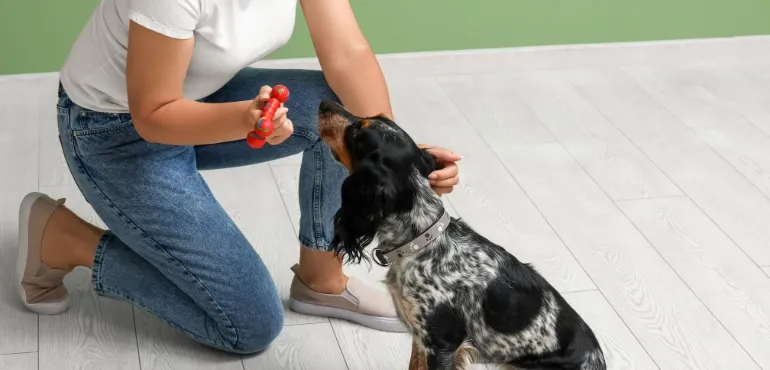
Private Dog Training Lessons in The Woodlands, TX: Personalized, In-Home Training That Works
You signed up for that group obedience class at the pet store, excited to finally teach your dog basic commands. Three weeks in, your dog has learned exactly one thing: that the other dogs are way more interesting than you are. The instructor moves through material at a pace that’s either too fast for your struggling dog or painfully slow because they already know these basics. You’re paying for group instruction but getting almost no individual attention. Here’s what dog owners in The Woodlands are discovering: when you need real behavior change that sticks, private dog training lessons deliver results that group classes simply can’t match.
Private dog training isn’t just group class shrunk down to one student. It’s a fundamentally different approach where every minute of instruction is tailored to your dog’s specific needs, learning style, and behavioral challenges. At The Mannered Mutt, our Private Lessons program brings personalized, one-on-one training directly to your home in The Woodlands, Conroe, and throughout Montgomery County—working on the exact behaviors you need addressed, in the environments where they actually occur.
This guide will help you understand why private training produces faster, more reliable results than group classes, what to expect from personalized sessions, and how to choose the right private training program for your dog’s specific needs.
Why Choose Private Dog Training Over Group Classes?

Group classes work for basic socialization and simple obedience with easy dogs. But for most real-world behavior challenges, private dog training lessons offer distinct advantages group settings cannot provide.
Undivided attention accelerates learning. In a group class with 8-12 dogs, your dog might receive 5-10 minutes of direct instructor attention per hour. In private training, that entire hour focuses exclusively on your dog—allowing trainers to immediately correct mistakes, reinforce progress, and adjust techniques in real-time.
Training happens in your actual environment. Group classes occur in generic facilities. But your dog’s problems happen at home—jumping on guests at your front door, barking through your window, pulling on neighborhood walks. Private, in-home dog training addresses behaviors where they actually occur.
Customized pace matches your dog. Group classes move at an average pace that serves no one perfectly. Private training adjusts to your dog—spending more time on difficult concepts, moving quickly through mastered skills.
According to research published in 2004 examining dog training methods and their effectiveness, owners’ ratings for their dogs’ obedience correlated positively with tasks trained using rewards, but not with punishment-based methods. This research demonstrated that positive reinforcement training—far easier to implement in one-on-one settings—produces superior obedience outcomes.
Behavioral issues get proper attention. If your dog has reactivity, aggression, or severe anxiety, group classes aren’t equipped to address these. Private training allows certified trainers to work directly on serious behavioral challenges with focused attention and customized protocols.
| Feature | Group Classes | Private Dog Training Lessons |
|---|---|---|
| Instructor Attention | 5-10 min per hour per dog | Full session focused on your dog |
| Training Location | Generic training facility | Your home, neighborhood, real environments |
| Learning Pace | Fixed, average pace | Customized to your dog’s speed |
| Behavior Issues | Basic obedience only | Can address complex problems |
| Scheduling | Fixed class times weekly | Flexible, arranged around your schedule |
| Distraction Level | High (other dogs, people) | Controlled, gradually increased |
| Cost Per Session | $15-30/class | $499+ for comprehensive packages |
| Results Timeline | 6-8 weeks for basics | Often see progress in 2-3 sessions |
What Are the Benefits of In-Home Dog Training?
Bringing training directly to your home provides advantages beyond convenience—it fundamentally changes how effectively dogs learn and apply new behaviors.
- Dogs learn where behaviors actually matter. Your dog doesn’t need to know “sit” in a sterile training room—they need it at your front door when guests arrive, in your kitchen while you’re cooking, on your sidewalk when another dog approaches. In-home training teaches commands in the exact contexts where you’ll use them daily.
- Trainers identify environmental factors. When a certified trainer comes to your home, they observe your dog’s actual living situation—the window your dog barks through, the doorway where jumping happens, the furniture arrangement enabling counter-surfing. These observations allow specific recommendations that directly reduce problem behaviors.
- Family members learn together. In-home training allows multiple household members to participate, ensuring everyone learns proper techniques and maintains consistency. This is especially important for families with children.
- Reduced stress for anxious dogs. Dogs who are fearful or overwhelmed in new environments often shut down in group class settings. Training at home, where they feel safe, allows these dogs to focus on learning rather than managing anxiety.

What Proven Training Techniques Does The Mannered Mutt Use?
Effective private dog training requires more than just one-on-one attention—it requires research-backed methods delivered by trainers who understand canine learning theory and behavior.
Positive reinforcement forms the foundation. At The Mannered Mutt, every Private Lesson uses reward-based training where desired behaviors are marked and reinforced with treats, praise, play, or other rewards your dog values. This approach creates dogs who are eager to learn, confident in their abilities, and genuinely enjoy training sessions. Paulina, our Master Trainer certified since 2012, has seen firsthand how positive reinforcement produces not just obedience but enthusiastic cooperation.
Research by Butler, Sargisson, and Elliffe (2011) on effective dog training demonstrated the efficacy of systematic desensitization for treating separation-related problem behaviors in domestic dogs. This evidence-based approach to modifying emotional responses is exactly what The Mannered Mutt implements in private sessions for anxious dogs.
Behavioral assessments create customized training plans. Every private training client begins with a thorough behavioral assessment where the trainer evaluates your dog’s temperament, learning style, existing skills, specific problem behaviors, and training goals. This assessment creates a roadmap for your personalized training plan, ensuring every session builds systematically toward your objectives.
Professional dog training programs consistently emphasize the importance of structured training environments. Research by Rutter et al. (2021) on conservation detection dogs demonstrated that with proper, structured training protocols, even volunteers could successfully train companion dogs to detect novel odors in a controlled environment within just 12 weeks—highlighting the power of consistent, well-designed training plans.
Clear communication through marker training. Many Private Lesson clients learn clicker training or verbal marker techniques that provide precise, immediate feedback when their dog performs correctly. This clarity accelerates learning by removing ambiguity about which behavior earned the reward, allowing dogs to understand expectations faster.
| Training Technique | How It Works | Benefits | Used For |
|---|---|---|---|
| Positive Reinforcement | Reward desired behaviors with treats, praise, play | Builds enthusiasm, confidence, willing cooperation | All training, all dogs |
| Marker Training (Clicker) | Sound marks exact moment of correct behavior | Provides precise feedback, accelerates learning | Teaching new behaviors, shaping complex skills |
| Behavioral Modification | Systematic desensitization, counter-conditioning | Changes emotional response to triggers | Fear, anxiety, reactivity, aggression |
| Impulse Control Exercises | Teach “wait,” “stay,” “leave it” in distractions | Develops self-regulation, reduces impulsivity | Hyperactivity, pulling, jumping, reactivity |
| Real-World Practice | Train in actual home/neighborhood environments | Ensures skills transfer to daily life | All training goals |
Flexible methodology adapts to individual dogs. Not all dogs respond identically to the same techniques. Some are highly food-motivated; others prefer play or praise. Some learn quickly through repetition; others need creative approaches to maintain engagement. Private training allows certified trainers to adjust methods continuously based on what works best for your specific dog rather than forcing all dogs through identical protocols.
WWhat Should You Expect from Private Dog Training Sessions
Understanding what happens during private lessons helps you prepare for training and maximize results between sessions.
Initial consultation and assessment. Your first session begins with comprehensive discussion of your dog’s history, current behaviors, challenges, and training goals. The trainer observes your dog’s behavior, tests current skills, and evaluates temperament to create your customized training plan.
Structured training with hands-on coaching. Each session includes active training where the trainer works with your dog to demonstrate techniques, then coaches you through implementing those same methods. This ensures you’re learning the skills to continue training effectively between sessions.
Homework assignments between sessions. Private training isn’t just the trainer’s time with your dog—it’s the daily practice you do at home. Trainers provide specific homework assignments and troubleshooting guidance.
Progressive skill building. Most programs involve a series of sessions scheduled weekly or bi-weekly, with each building on previous progress. Early sessions establish foundations; later sessions add complexity and practice real-world scenarios.
Typical session structure: Private sessions with The Mannered Mutt include progress review, introduction of new skills, practice in various locations with added distractions, and homework discussion to ensure you feel confident moving forward.hat Role Do Certified Trainers Play in Behavior Modification?
Certified trainers play a crucial role in behavior modification by applying their expertise to assess and address specific behavioral issues. They utilize positive reinforcement techniques and behavioral assessments to develop customized training plans that cater to each dog’s needs. The knowledge and experience of certified trainers ensure that training is effective and safe, providing dog owners with the confidence that they are receiving professional guidance.
Professional dog training programs often begin with an initial assessment to tailor a comprehensive training plan, as evidenced by structured programs involving professional trainers.
What Should You Expect from Private Dog Training Sessions?
Understanding what happens during private lessons helps you prepare for training and maximize results between sessions.
Initial consultation and assessment. Your first session begins with comprehensive discussion of your dog’s history, current behaviors, challenges, and training goals. The trainer observes your dog’s behavior, tests current skills, and evaluates temperament to create your customized training plan.
Structured training with hands-on coaching. Each session includes active training where the trainer works with your dog to demonstrate techniques, then coaches you through implementing those same methods. This ensures you’re learning the skills to continue training effectively between sessions.
Homework assignments between sessions. Private training isn’t just the trainer’s time with your dog—it’s the daily practice you do at home. Trainers provide specific homework assignments and troubleshooting guidance.
Progressive skill building. Most programs involve a series of sessions scheduled weekly or bi-weekly, with each building on previous progress. Early sessions establish foundations; later sessions add complexity and practice real-world scenarios.
Typical session structure: Private sessions with The Mannered Mutt include progress review, introduction of new skills, practice in various locations with added distractions, and homework discussion to ensure you feel confident moving forward.
Why Work with Certified Trainers at The Mannered Mutt?
Professional credentials and experience directly impact training effectiveness.
Certification ensures evidence-based methods. Paulina’s Master Trainer certification (earned in 2012) represents years of study and ongoing education in the most current, effective training approaches.
Experience with diverse challenges. Through hundreds of client dogs in Montgomery County, our trainers have encountered virtually every behavior problem—and developed proven protocols for addressing them.
Comprehensive support. The Mannered Mutt provides extensive support to ensure your success. We don’t just train your dog and disappear; we build relationships that help you navigate challenges as they arise.
Local expertise matters. Trainers familiar with The Woodlands and Montgomery County understand specific challenges dog owners face in our area, making training more relevant and immediately applicable.
What Training Resources Support Private Lesson Success?
Private training works best when supported by appropriate tools, resources, and ongoing education between sessions.
Recommended training tools that complement Private Lessons include: quality 6-foot training leash (not retractable), properly fitted flat collar or harness, high-value training treats (small, soft, smelly), clicker or verbal marker if using marker training, and treat pouch for convenient access during training. Your trainer will provide specific equipment recommendations during your initial consultation.
Between-session support resources help maintain progress. At The Mannered Mutt, Private Lesson clients receive clear instructions and support for troubleshooting questions between sessions. This comprehensive support ensures you’re never stuck wondering what to do next.
Continued education opportunities allow you to build on Private Lesson foundations. After completing a basic obedience program, many clients progress to advanced training or specialized skills like off-leash reliability. These pathways keep training engaging for both you and your dog long-term.
How Do You Get Started with Private Dog Training in The Woodlands?
Beginning your private training journey is straightforward—but choosing the right program requires consideration.
- Assess your needs and goals. Before contacting trainers, clarify what you want to accomplish—addressing specific behavior problems, teaching basic obedience, training a new puppy, or preparing for off-leash reliability.
- Research trainer credentials. Look for certifications, verify they use positive reinforcement, read client testimonials, and ask about experience with your specific needs. At The Mannered Mutt, transparency about Paulina’s credentials and methods helps you make informed decisions.
- Schedule a consultation. Most professional trainers offer initial consultations where they assess your situation, discuss goals, explain their approach, and provide pricing.
- Commit to the process. Private training produces results when owners implement homework consistently and maintain training principles long-term.
Contact The Mannered Mutt at 936-506-2646 or visit manneredmutt.com to schedule your private training consultation.
Frequently Asked Questions About Private Dog Training
Is private training better for a dog that is easily distracted?
Yes. Private training allows the trainer to control the level of distraction, starting in a quiet environment and gradually introducing real-world distractions only when your dog is ready to succeed.
Will in-home training help with my dog's territorial barking?
Absolutely. In-home training is the most effective way to address territorial barking because the trainer can observe the specific triggers (like the mail carrier or people walking by) and implement counter-conditioning techniques in the exact location the behavior occurs.
Do I need to be present for every private training session?
Yes, your participation is crucial. Private lessons are designed to train you how to train your dog. The goal is to build your handling skills and confidence so you can maintain your dog’s good behavior long after the professional training has concluded
What kind of treats should I use for training?
We recommend using high-value treats that are small (pea-sized), soft (quick to eat), and smelly. Things like small pieces of hot dog, cheese, or specialized training treats work best. The goal is to use something your dog finds highly motivating but can consume quickly so training isn’t interrupted.
How many private training sessions will my dog need?
Most dogs benefit from a comprehensive package of sessions for basic obedience or moderate behavior issues, though complex problems may require more. Your trainer will provide a recommended timeline during your initial assessment based on your specific goals and your dog’s current skill level. Consistent homework practice between sessions significantly affects how quickly you see results.
