We do not use one universal age or vaccine rule for every puppy. Puppies need early, positive experiences, and they also need protection from infectious disease. The right decision depends on your puppy’s health, vaccine history, local disease risk, your veterinarian’s guidance, and the policies of the class provider.
A well-managed puppy class may be one option. So may controlled exposure at home, in a clean environment, with healthy animals you know. Before enrolling, we recommend asking detailed questions and bringing the class plan to your veterinarian.
Puppy Vaccines and Socialization: Can Puppies Socialize Before All Vaccines?
Often, yes, but socialization before full vaccination should be planned carefully rather than treated as a free pass to visit every public dog area. Socialization means helping a puppy have safe, positive experiences with people, animals, places, sounds, surfaces, handling, and everyday routines. It does not require direct contact with every dog or exposure to environments with unknown health risks.
The American Veterinary Society of Animal Behavior, or AVSAB, identifies early puppyhood as an important socialization period and supports safe socialization before a puppy has completed the entire vaccine series. Its Puppy Socialization Position Statement also emphasizes current vaccinations, deworming, disease-free puppies, cleanable surfaces, and avoiding unsanitized areas heavily used by dogs of unknown health status.
That guidance does not clear every puppy for every class. It is a professional position statement, not a substitute for your veterinarian’s assessment of your puppy’s health, vaccine schedule, and local risk.
Why Is Early Puppy Socialization Important?
When we talk about early socialization, we mean helping a puppy learn how to respond to new experiences before unfamiliar people, animals, places, and sounds become more difficult to process. The goal is not to make your puppy interact with everything. The goal is to build calm, flexible responses while paying attention to the puppy’s comfort.
A puppy can learn from watching people pass by, walking across a new surface, hearing household sounds, riding in the car, or meeting one calm and healthy dog in a controlled setting. A short, successful experience is usually more useful than a long outing that leaves the puppy frightened, frantic, or unable to recover.
The American Animal Hospital Association’s canine behavior guidance also describes positive, structured exposure during sensitive developmental periods as important. It notes that puppy classes and social exposure do not necessarily need to wait until the vaccine series is complete when exposure to sick animals is prevented and basic hygiene is practiced.
This is why “stay home until every vaccine is finished” can be too broad as general advice. At the same time, “take your puppy everywhere” is also too broad. The safest plan balances developmental needs with disease prevention.
Puppy Vaccines and Socialization: When Can Training Class Start?
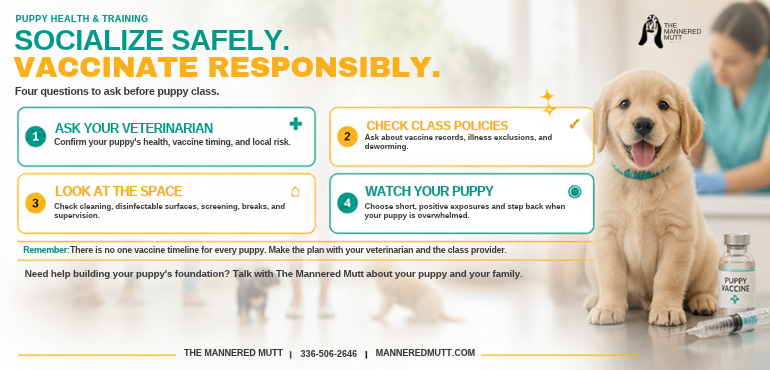
There is no single class-start date that is correct for every puppy. Ask your veterinarian when your puppy can safely attend a specific class, then confirm that the provider’s health and sanitation policies match that advice.
AVSAB’s position statement describes puppy socialization classes beginning as early as 7 to 8 weeks in appropriate circumstances, with vaccination and deworming requirements. VCA’s veterinary guidance on when to start puppy classes similarly discusses early socialization while recommending proof of vaccination and an easily disinfected class environment.
Your veterinarian may consider factors such as:
- your puppy’s age and medical history;
- which vaccines have been given and when;
- the timing of the next vaccines;
- deworming and parasite prevention;
- illness or symptoms in your puppy;
- disease activity and environmental risk in your area;
- the class location and the provider’s cleaning procedures;
- whether your puppy will contact dogs or surfaces of unknown health status.
Do not rely on a generic online timeline if your puppy is ill, has missed vaccines, has a medical condition, or has a health history that needs individual review. Call your veterinary practice before class and ask what information they need to make a recommendation.
What Should a Responsible Puppy Class Require?
When we help an owner evaluate a class, we want the provider to explain its health screening, vaccination, sanitation, puppy-matching, and instructor-support policies before enrollment. The provider should also have a plan for puppies that are fearful, overwhelmed, sick, or unable to participate comfortably.
Vaccine And Health Records
Ask the class provider:
- What vaccine records are required before the first class?
- Is there a waiting period after a vaccine is given?
- Is a first deworming required?
- Must puppies remain current on vaccines throughout the class?
- Are puppies with coughing, diarrhea, vomiting, nasal discharge, or other illness symptoms excluded?
- What happens if a puppy becomes sick between sessions?
The provider’s policy should be clear and consistent. If a class does not request any health information or cannot explain how sick puppies are handled, ask more questions before bringing your puppy.
Cleaning And Class Surfaces
Ask how the room, floors, gates, equipment, toys, and other shared surfaces are cleaned and disinfected. Ask whether accidents are handled immediately and whether the class takes place on surfaces that can be cleaned effectively.
VCA recommends puppy classes that require proof of vaccination and use environments that can be disinfected easily. AVSAB also recommends cleanable class surfaces and cautions against areas that are highly trafficked by dogs of unknown vaccination or disease status.
A clean room does not remove every risk. It does show that the provider has considered disease prevention as part of the class design.
Puppy Screening And Group Management
Ask how puppies are screened and grouped. A provider may consider age, size, health, energy level, previous experience, and behavior around other dogs.
Ask whether puppies are required to interact directly. Good socialization does not mean forcing every puppy to play. A puppy may benefit from watching other dogs from a distance, practicing calm check-ins, taking breaks, or working with their owner behind a barrier.
Also ask what happens when one puppy is barking, hiding, freezing, pulling, or becoming too rough. The instructor should be able to adjust distance, activity, and duration rather than expecting every puppy to follow the same plan.
Breaks And Owner Coaching
Puppies need opportunities to rest and recover. Ask whether the class includes breaks, quiet spaces, short training periods, and guidance for recognizing stress or overstimulation.
Owner coaching matters as much as puppy participation. We want you to leave knowing what to practice at home, how to make an exercise easier, and what to do if your puppy cannot eat, respond, settle, or recover in class.
What Are Safer Ways to Socialize a Puppy Before Full Vaccination?
Safer socialization focuses on controlled experiences where you can manage contact, distance, surfaces, and duration. Your veterinarian can help you decide which options are appropriate for your puppy.
Possible options may include:
- meeting healthy, familiar, appropriately vaccinated dogs in a clean private setting;
- inviting one calm visitor at a time into your home;
- carrying your puppy or using a clean carrier while observing the world from a safe distance;
- taking short car rides and visiting quiet locations without allowing contact with contaminated surfaces;
- practicing handling of paws, ears, collar, harness, and grooming tools at home;
- introducing household sounds, textures, movement, and equipment gradually;
- attending a puppy class that meets your veterinarian’s advice and uses clear health controls.
Watch your puppy’s response throughout the experience. Signs that the situation may be too difficult include hiding, freezing, crouching, repeated escape attempts, frantic pulling, persistent barking, refusing familiar treats, or being unable to recover after the trigger is gone.
If your puppy becomes overwhelmed, create distance or end the interaction. The Mannered Mutt’s guide to socializing new puppies also emphasizes short, controlled introductions and ending an interaction when a puppy becomes overwhelmed.
What Should Texas Puppy Owners Ask a Local Class Provider?
If you are comparing puppy classes in Conroe, The Woodlands, Willis, or another Texas community, we encourage you to ask questions that address both health and training quality. Local conditions can affect disease risk, and class policies may differ from one provider to another.
- What vaccine and deworming records must I provide?
- What illnesses require a puppy to stay home, and can the class reschedule safely?
- How often are floors, gates, equipment, and shared surfaces cleaned?
- Is the class held indoors on a surface that can be disinfected?
- How many puppies attend, and how are they screened or grouped?
- Can my puppy observe from a distance instead of greeting or playing?
- Are breaks and quiet areas available?
- What will the instructor do if my puppy is fearful, overexcited, barking, or unable to focus?
- How much owner coaching and home practice is included?
- Should I ask my veterinarian about any additional lifestyle vaccines for this setting?
A provider should welcome these questions. You are not being difficult by asking how the class protects puppies and supports learning.
When Should I Ask My Veterinarian Before Attending Class?
Ask your veterinarian before class whenever you are unsure about the timing or risk, and always ask if your puppy is sick, has missed vaccines, has a chronic condition, or has a medical history that may change the recommendation.
Contact your veterinarian promptly if your puppy develops vomiting, diarrhea, coughing, nasal discharge, unusual tiredness, loss of appetite, fever, pain, or another sign of illness. Do not take a potentially sick puppy to class while waiting to see whether the symptoms improve.
Veterinary guidance is also important when your puppy shows persistent fear, severe distress, or behavior that makes handling or proximity to people and dogs unsafe. A trainer can help with training and owner coaching, but training should not replace veterinary evaluation when a medical contributor or significant behavior concern is possible.
How Can The Mannered Mutt Help With Puppy Socialization?
At The Mannered Mutt, we offer puppy training options for families in Conroe, The Woodlands, Willis, Montgomery, Spring, Magnolia, and nearby Montgomery County communities. Current options include a 3-Week Puppy Manners Board and Train for puppies 12 weeks to 5 months and Puppy 101 in-home private lessons for puppies up to 5 months, with eligibility and current program details confirmed through our team.
We may recommend private in-home support when your puppy needs a calmer starting point, when your household needs help building routines, or when a group environment is not the right fit yet. Private support does not replace safe socialization, but it can help you build the handling, settling, leash, name-response, and household skills your puppy needs before adding more distractions.
Conclusion
Puppy vaccines and socialization do not have to be competing priorities, but the balance needs to be individualized. Start with your veterinarian’s guidance, choose controlled experiences, and evaluate the class provider’s health screening, sanitation, surfaces, puppy matching, breaks, and owner coaching.
If your puppy is healthy and the class is well managed, early training may support both socialization and foundational skills. If the group setting is not a good fit, private puppy training and carefully planned experiences at home can help you build a calmer foundation while you continue working with your veterinarian.