
Your puppy barked, pulled, whined, hid behind your legs, or could not focus around the other dogs. You left the first class embarrassed and unsure whether to return.
A difficult first class does not mean your puppy is bad or that you chose training incorrectly. It usually means the environment was more difficult than your puppy could handle that day. The next step is to help your puppy recover, talk with the instructor, and adjust the plan before asking for more exposure.
Puppy classes can be useful when they are well managed and matched to the puppies in the room. The American Veterinary Society of Animal Behavior supports safe, positive socialization during early puppyhood, including organized puppy classes, while cautioning that new experiences should not create excessive fear, withdrawal, or avoidance. Read the AVSAB Position Statement on Puppy Socialization.
Why Did My Puppy Class Go Badly?
A puppy may struggle in class because the combination of other dogs, unfamiliar people, new smells, movement, sounds, handling, confinement, and owner expectations is too much at once. The behavior may look like disobedience, but your puppy may be overexcited, worried, tired, or unable to process the environment.
Common signs that class was too difficult include:
- barking or whining that continues despite increased distance;
- pulling toward dogs or trying to escape from them;
- hiding behind you, freezing, crouching, or repeatedly turning away;
- refusing treats that your puppy normally enjoys;
- frantic jumping, nipping, spinning, or inability to settle;
- inability to respond to a familiar name or easy cue;
- slow recovery after a startling sound, dog, person, or handling exercise.
One sign by itself does not tell you exactly why your puppy struggled. It does tell you to pause and look at the setup instead of simply repeating the same exposure.
Puppies also arrive with different sleep, potty, feeding, social, and developmental histories. A confident puppy may investigate the room quickly, while a more sensitive puppy may need distance, breaks, and several easier visits before they can learn around other dogs.
Should I Take My Puppy Out of Class if They Are Overwhelmed?
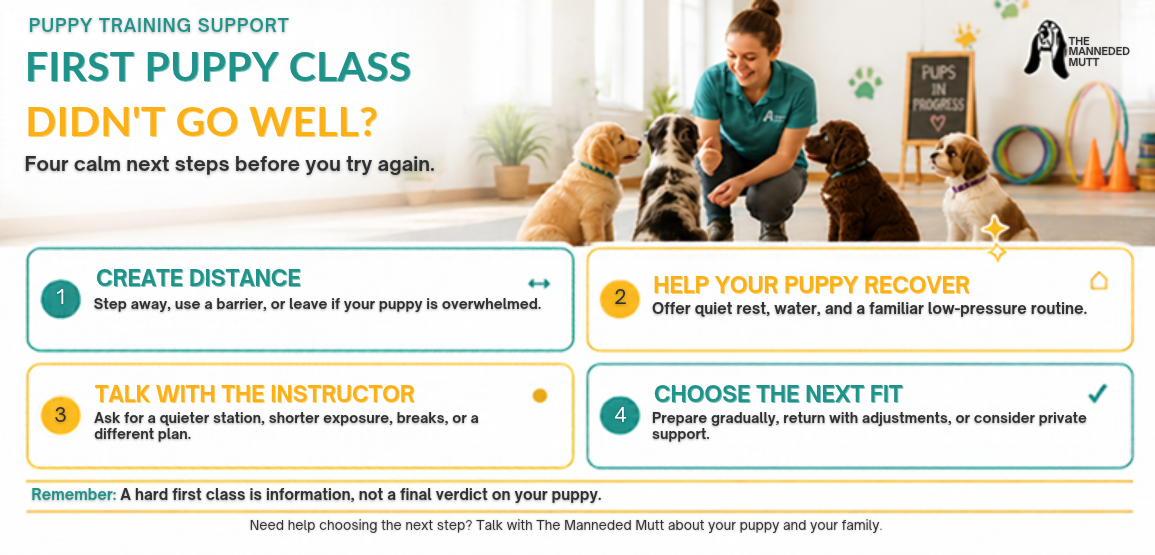
Yes. If your puppy is showing sustained fear, frantic behavior, escape attempts, or an inability to recover, calmly move farther away or leave the class rather than forcing the puppy to continue.
Taking a break is not rewarding bad behavior or giving up on socialization. It is a way to prevent the experience from becoming more intense while you give your puppy a chance to recover.
Ask the instructor whether there is a quiet corner, separate room, visual barrier, or outdoor area where your puppy can decompress. If your puppy can settle at a distance, you may be able to observe the rest of the class without participating. If not, it is reasonable to end the session.
Do not drag your puppy toward the group, hold the puppy in place while other dogs approach, or insist on greetings because the class is already underway. The AVSAB guidance recommends exposing puppies to new experiences safely and without excessive fear, withdrawal, or avoidance. AVSAB’s puppy socialization guidance can help explain why a smaller, more controlled step may be more useful than prolonged exposure.
What Should I Do After a Difficult Puppy Class?
Give your puppy a quiet recovery period, write down what happened, and contact the instructor before the next class. Avoid adding several new challenges immediately after a difficult session.
Let Your Puppy Decompress
Keep the rest of the day predictable. Offer water, a familiar meal, a quiet place to rest, and a low-pressure activity such as sniffing in a safe area or working on an easy food toy.
Your puppy may sleep more than usual after a stimulating experience. That is different from ongoing fear or illness. If your puppy continues to seem distressed, stops eating normally, develops signs of illness, or shows a sudden behavior change, contact your veterinarian.
Record the Details
Write down what happened before the behavior changed. Include where your puppy was positioned, how close the other dogs were, whether dogs were barking or moving, how long your puppy had been in the room, what reward you offered, and how long recovery took.
This turns “class was terrible” into useful information. You may discover that your puppy was comfortable watching from the doorway but struggled when placed in the center, or that the problem began after a play period rather than during training.
Contact the Instructor Early
A good instructor should want to know when a puppy is overwhelmed. Ask what they observed, what adjustments they can make, and whether they recommend attending the next class, arriving early for a quieter entry, observing without participating, or switching to private support.
The instructor may be able to create more distance, use a visual barrier, shorten your puppy’s participation, change the exercise, reduce group play, or give you a separate station. If the response is to force the puppy closer, ignore sustained distress, or shame you for leaving, that is important information when deciding whether the class is a good fit.
How Can I Prepare My Puppy for the Next Group Class?
Prepare by making the class environment easier before asking your puppy to perform around a full group. Practice short, positive exposures and build your puppy’s ability to notice distractions while remaining able to eat, move, and respond.
1. Confirm Your Veterinarian’s Guidance
Ask your veterinarian about age-appropriate vaccinations, parasite prevention, and the health risks in your area. Puppy-class policies vary, and your puppy’s medical history and local disease conditions matter.
AVSAB generally supports puppy socialization classes as early as 7 to 8 weeks when puppies have received a first set of vaccines at least seven days before the first class, have been dewormed, remain current on vaccinations, and attend a properly managed environment. Review the current AVSAB class and vaccination guidance, then confirm the plan with your veterinarian and the class provider.
2. Practice the Building Blocks at Home
Before class, practice responding to your puppy’s name, taking food gently, following a hand target, settling on a mat, and moving with you on a leash. Keep the sessions short and finish while your puppy is still successful.
These skills do not need to be perfect. They give your puppy familiar behaviors to use when the new environment becomes distracting.
3. Visit the Location Without Joining the Class
If the provider allows it, visit the building at a quiet time. Let your puppy notice the entrance, floor, smells, voices, and equipment from a comfortable distance, then leave before your puppy becomes overwhelmed.
You can also practice near, but not inside, other low-pressure environments. Your puppy might watch people from the car, walk briefly near a quiet store entrance, or notice a calm dog from a safe distance. The goal is not to meet everyone. It is to build calm observation and recovery.
For more ideas, read our guide to socializing new puppies, which emphasizes short, controlled introductions and ending an interaction when a puppy becomes overwhelmed.
4. Protect Sleep, Potty, and Food Routines
An overtired or uncomfortable puppy may have less ability to learn. Give your puppy time to nap, potty before class, and eat according to your veterinarian’s or breeder’s guidance.
Ask the instructor whether food should be withheld briefly before class or whether your puppy should arrive with a normal meal. Do not make a major feeding change without considering your puppy’s age, health, and veterinary advice.
5. Arrive Early and Choose Distance
Arriving early may give your puppy time to enter an empty or quieter room. Ask for a station at the edge of the group rather than placing your puppy in the center of the activity.
Keep enough space between your puppy and the other dogs for your puppy to notice them without immediately barking, pulling, hiding, or trying to escape. More distance is often a useful first adjustment.
6. Bring a Recovery Plan
Ask what you should do if your puppy becomes overwhelmed. A recovery plan may include stepping behind a visual barrier, taking a brief break, moving to a quiet area, observing from outside the room, or ending the session.
You should not have to improvise while your puppy is already distressed. The instructor should be able to explain how they will support both your puppy and the rest of the class.
What Should I Ask a Puppy Class Provider Before Enrolling?
Ask specific questions about the class structure, health policies, instructor support, and what happens when a puppy cannot participate comfortably. These questions are useful whether you are looking for puppy training in Conroe, The Woodlands, Willis, or another community.
Class Size And Puppy Matching
Ask:
- How many puppies are in each class?
- Are puppies grouped by age, size, energy, or experience?
- How are play periods supervised?
- Can puppies observe without direct interaction?
- What happens if one puppy is barking, fearful, or too rough for the group?
A smaller class is not automatically better, but the provider should be able to explain how the space, staffing, and curriculum support each puppy.
Health Screening And Sanitation
Ask:
- What vaccines and deworming records are required?
- Are sick puppies asked to stay home?
- How are floors, gates, bowls, toys, and other surfaces cleaned?
- Are there separate areas for waiting and class?
- What is the policy for accidents or suspected illness?
VCA recommends choosing puppy classes that require proof of vaccination and are held in environments that can be disinfected easily. Read VCA’s veterinary guidance on when to start puppy classes and discuss the appropriate timing with your veterinarian.
Breaks And Owner Coaching
Ask whether puppies receive rest breaks and whether owners are taught how to recognize early signs of stress. You should also know whether the instructor will adjust the exercise, give you a home practice plan, and explain what to do if your puppy cannot focus.
A class should not be judged only by how many cues your puppy performs. Owner coaching matters because the skills need to transfer to your home, visitors, walks, and other daily situations.
Is Private Puppy Training Better for a Fearful Puppy?
Private puppy training may be a better starting point when your puppy is consistently overwhelmed by group settings, cannot recover during breaks, or needs help with a specific concern. It is not automatically better for every puppy, and private lessons do not replace safe socialization.
Group classes can provide controlled exposure to other puppies, people, sounds, and movement when the environment is well managed and the puppy can participate comfortably. Private training can give you more distance, a slower pace, and direct coaching for your puppy’s specific needs.
Some puppies begin with private lessons and later join a carefully selected group. Others attend group class with adjustments while receiving extra help at home. The right progression depends on your puppy’s responses, recovery, health, age, and the support available from the provider.
Our Puppy School vs. At-Home Training guide explains that group and private formats serve different needs. Its current Puppy Manners program includes a 3-Week Puppy Manners Board and Train for puppies 12 weeks to 5 months and Puppy 101 in-home private lessons for puppies up to 5 months. The private lessons is an in-home coaching for Puppy 101 across Conroe, The Woodlands, Willis, Montgomery, Spring, and Magnolia.
These are current service descriptions, not a recommendation that one format fits every puppy. Contact the us to discuss eligibility, service fit, and your puppy’s behavior before booking.
When Should I Contact a Veterinarian or Behavior Professional?
Contact your veterinarian if your puppy shows a sudden behavior change, persistent fear, unusual withdrawal, loss of appetite, signs of pain or illness, or distress that continues outside the class setting. A veterinarian can help identify medical factors that may affect behavior and learning.
Seek qualified behavior support when your puppy repeatedly freezes, panics, attempts to escape, snaps, bites, or cannot recover from ordinary handling or proximity to people or dogs. Do not force exposure or punish barking, growling, hiding, or fearful behavior while you are trying to decide what to do next.
A first class can go badly without creating a lasting problem. The more important question is whether your puppy’s needs are recognized and whether the next experience can be made safer, shorter, and more manageable.
How Can The Mannered Mutt Help?
The Mannered Mutt provides puppy training options for families in Conroe, The Woodlands, Willis, Montgomery, Spring, Magnolia, and nearby Montgomery County communities. Current options include Puppy 101 in-home private lessons for puppies up to 5 months and a 3-Week Puppy Manners Board and Train for puppies 12 weeks to 5 months, with service details and pricing confirmed through the provider.
If your puppy cannot focus around other dogs, becomes overwhelmed in group settings, or needs a calmer foundation before more social exposure, contact The Mannered Mutt to discuss your puppy’s age, behavior, goals, and next step.
FAQs
Is It Normal for a Puppy to bark during Training Class?
Some barking is common when a puppy is excited, frustrated, uncertain, or overwhelmed by the new environment. Create more distance, reduce the difficulty, and watch your puppy’s overall body language before deciding how to respond.
How can I calm my puppy down during class?
Lorem ipsum dolor sit amet, consectetur adipiscing elit. Ut elit tellus, luctus nec ullamcorper mattis, pulvinar dapibus leo.
What should I do if my puppy will not take treats in class?
If your puppy refuses treats they normally enjoy, the environment may be too distracting or stressful for learning at that moment. Move farther away, offer a quiet break, and avoid forcing food or continuing the exercise until your puppy can settle.
Should I skip the next puppy class after a bad first class?
Do not automatically repeat the same setup, but you may not need to stop training altogether. Speak with the instructor about arriving early, using more distance, shortening your puppy’s participation, observing from outside the group, or trying private support first.
Can puppy classes make a puppy fearful?
A well-managed class should introduce new experiences gradually and avoid overwhelming puppies with prolonged fear, withdrawal, or escape behavior. If your puppy remains distressed or cannot recover after class, pause the current setup and speak with your veterinarian and a qualified behavior professional.
