
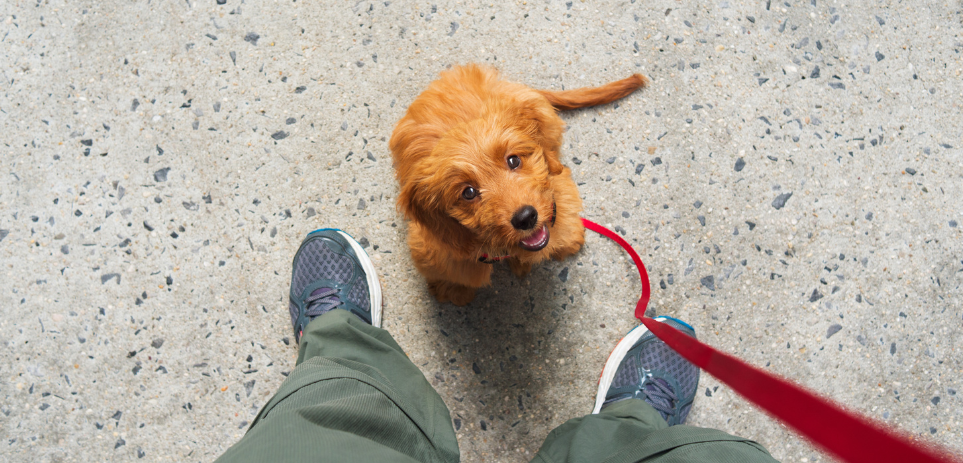
Your dog listens perfectly in the living room, then ignores commands the moment you step into the yard or onto the sidewalk.
This usually does not mean your dog is stubborn or that training failed. It means the behavior has not been practiced enough around changes in location, distance, distractions, or excitement.
Dogs do not automatically understand that a cue learned in one place applies everywhere. The way to build reliability is to make the exercise easier, change one variable at a time, and reward your dog for responding in gradually more difficult situations.
Why Does my Dog Obey Inside but not Outside?
Your dog may listen inside because the behavior is familiar, the environment is quiet, and you are easy to pay attention to. Outside, new smells, movement, people, dogs, wildlife, sounds, distance, and freedom compete with the cue.
Imagine asking for a calm sit in your kitchen, then asking for the same sit while a dog walks past the yard.
Those are not the same exercise from your dog’s point of view. The word may be familiar, but the situation is harder.
This is why a dog that responds to “come” in the hallway may ignore it at the fence. It is also why a dog may sit for you at home but pull, stare, or wander during a neighborhood walk. The skill needs to be taught in the places and situations where you expect to use it.
That does not make your dog bad. It gives you useful information about what to practice next.
What is Generalization in Dog Training?
Generalization is the process of teaching a dog that a learned behavior applies across different locations, people, distances, and levels of distraction.
A dog that has learned “sit” only in the kitchen may not yet understand that the same cue applies in the yard, at a friend’s house, or near a park.
The American Kennel Club (image) explains that dogs do not generalize well automatically. When you move to a new location, it can help to return to an easier version of the skill and build again.
Generalization is not a single final test. It is a gradual part of training. You build it by practicing a behavior in several settings while keeping the difficulty low enough for your dog to respond successfully.
What Makes a Familiar Cue Harder Outside?
Several changes can make a behavior more difficult even when the word has not changed.
The environment is new
Your yard, a quiet neighborhood street, and a busy park each contain different smells, sounds, surfaces, and movement. Your dog may need time to notice and process those changes before they can focus on you.
The distraction is more valuable
A squirrel, another dog, a delivery person, or an interesting scent can be more rewarding than the treat or praise you are offering. This is not a moral decision. Your dog is responding to what is most important in that moment.
You are farther away
A dog that sits beside you may not sit when you are several feet away. Distance is a separate part of the exercise, especially for stay, place, and recall.
The behavior lasts longer
A one-second sit is easier than a one-minute sit. A short wait at an interior doorway is easier than waiting while the front door opens and a visitor walks in.
Your dog is too excited or worried to learn
If your dog is pulling, barking, scanning, freezing, hiding, or unable to take a familiar reward, the situation may be too difficult. Continuing to repeat the cue will not make the environment easier. Move farther away, reduce the distraction, or return to a simpler version of the exercise.
How Do you Make a Cue Reliable Around Distractions?
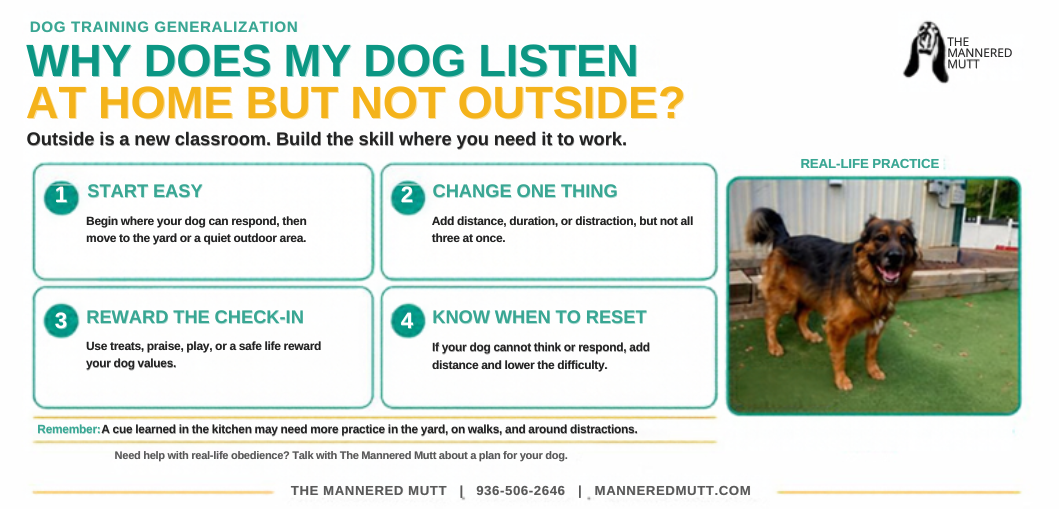
Start where your dog can succeed, then increase difficulty in small steps. The American Kennel Club describes three useful training variables: duration, distance, and distraction. It recommends working on one at a time before combining them.
1. Start with an easy version
Choose a quiet room and a behavior your dog already performs comfortably. Ask once, mark the correct response with a word such as “yes,” and reward promptly.
Keep the first sessions short. You are building a pattern of responding, not testing how long your dog can work.
2. Change one variable at a time
If your dog can sit beside you for five seconds indoors, do not immediately ask for a 30-second sit from across the yard while another dog walks by. Change one part of the exercise instead.
You could:
Keep the distance the same and add one mild sound.
Keep the distraction low and take one step away.
Keep the distance short and ask for one extra second.
Move to a new room but return to a short, easy behavior.
When you change several variables at once, it becomes difficult to tell what made the exercise too hard.
3. Add location changes gradually
After your dog succeeds inside, try the doorway, then a quiet part of the yard, then a calm area near the home. Practice the same cue in different rooms and positions before expecting it to work in a busy setting.
For owners in The Woodlands, Conroe, and Montgomery County, this may mean building from a living room to a yard, then a quiet neighborhood walk, and only later a busier public setting. You do not need to take your dog to the most distracting place available to prove progress.
4. Adjust the reward to the difficulty
The reward should matter to your dog and fit the challenge. A small piece of a favorite treat, a toy, praise, a short game, or permission to sniff may all be useful, depending on the dog and situation.
You can also use life rewards. For example, your dog checks in with you, then gets permission to sniff. Your dog walks with a loose leash, then moves forward. Your dog comes when called in a safe enclosed area, then the fun continues.
Do not use recall to end every enjoyable activity. If “come” always means the leash goes on, play ends, or you leave the park, your dog may become less willing to respond.
Practice coming, reward generously, and sometimes release your dog back to an appropriate activity.
The American Veterinary Society of Animal Behavior recommends reward-based training for dog training and behavior modification. Its guidance also emphasizes choosing humane training practices that protect welfare and the human-animal relationship.
5. Keep safety ahead of proofing
Do not test an unreliable recall off leash near traffic, an open gate, wildlife, or unfamiliar dogs. Use a secure fenced area or an appropriate leash setup while you build the behavior.
Likewise, do not move closer to a trigger simply to see whether your dog can handle it. Distance is a useful training tool. If your dog can respond at 30 feet but not 15 feet, work at the distance where success is possible and reduce it gradually.
How Do you Know When an Exercise is too Difficult?
The exercise is probably too difficult when your dog repeatedly fails, stops taking rewards, cannot disengage from a distraction, or shows signs of fear or intense distress.
Other signs may include freezing, hiding, frantic pulling, barking, lunging, or constant scanning.
A single mistake is not a crisis. Lower the difficulty and try again. If your dog continues to struggle, end the session and choose an easier practice opportunity later.
Use this quick checklist before you increase the challenge:
Can my dog respond in the current location?
Can my dog take a reward and return attention to me?
Am I changing only one variable?
Is the distance from the distraction appropriate?
Is the session short enough?
Can I keep everyone safe if my dog does not respond?
If the answer to several questions is no, the next step is probably not more pressure. It is a simpler setup.
What Should you Track During Practice?
A short training log can help you see progress that is easy to miss. Record the cue, location, distance, distraction, reward, and result.
For example:
Cue: Come
Location: Fenced yard
Distraction: Family member standing nearby
Distance: Six feet
Result: Responded four out of five times
Next step: Repeat at the same distance before adding movement
This turns “my dog never listens outside” into a more useful question: “Which part of the exercise needs to become easier?”
Look for patterns. Your dog may respond well in the yard but struggle on walks. They may listen to you but not another family member.
They may handle people at a distance but become overwhelmed when a dog passes nearby. These details help you choose the right next step.
When Should you Get Individualized Obedience Training?
Consider individualized help when your dog makes little progress despite careful practice, when the behavior creates a safety concern, or when you cannot identify a manageable starting point.
Private training can give you feedback on timing, distance, rewards, handling, and the environment where the behavior is breaking down.
The Mannered Mutt’s private lessons and obedience training programs address practical skills such as coming when called, place, stay, leash manners, and working around distractions. The appropriate format depends on your dog’s behavior, your goals, and the level of support your household needs.
If your dog suddenly stops responding to familiar cues or shows a sudden change in behavior, contact your veterinarian.
Pain, illness, fear, or another change in your dog’s wellbeing can affect behavior, so training should not be used to explain away an abrupt change.
For serious aggression, bite risk, severe fear, or intense distress, prioritize management and professional assessment. Do not force your dog closer to a trigger or use pain, intimidation, or fear as a default solution.
How can The Mannered Mutt Help?
The Mannered Mutt works with dog owners in Willis, The Woodlands, Conroe, Montgomery County, and nearby communities.
Its programs are designed around practical communication and real-life skills, not only what your dog can do in a quiet room.
If your dog listens at home but ignores commands outside, bring a clear example to the conversation.
Tell the trainer where the behavior works, where it falls apart, what distractions are present, and what you have already tried. You can contact The Mannered Mutt to discuss a training plan for your dog and your family.
Conclusion
When your dog listens at home but not outside, the problem is often a gap in generalization rather than a lack of intelligence or effort. Make the exercise easier, change one variable at a time, use meaningful rewards, and practice in the places where you need the skill to work.
Your dog does not need to be perfect on the first neighborhood walk. They need a clear path from the living room to the yard, from the yard to the sidewalk, and from quiet practice to real-life distractions.
If you feel stuck, individualized obedience training can help you understand what your dog is communicating and what to practice next.
FAQs
Why does my dog listen in the house but not in the yard?
The yard adds smells, sounds, movement, and freedom that may not be present inside. Return to an easier version of the cue outdoors and build difficulty gradually.
What is the fastest way to teach a dog to listen outside?
There is no single shortcut, but starting at a quiet outdoor location and rewarding small successes can make practice more effective. Increase only one challenge at a time instead of moving straight to a busy park.
Should I repeat a command if my dog ignores me?
Repeatedly saying a cue can teach your dog that the first request is optional. If your dog is too distracted to respond, make the situation easier and practice the cue later rather than repeating it over and over.
How far away should my dog be from a distraction?
Your dog should be far enough away to notice the distraction and still eat, think, and respond. The right distance depends on the individual dog and may need to increase when the distraction becomes more exciting.
Can treats make my dog dependent on food?
Rewards help your dog understand which behavior works, especially when the environment is difficult. As the skill becomes more reliable, a trainer can help you vary rewards while continuing to reinforce the behavior.
