
Will my Dog Always Need Treats?
What is the Difference Between a Lure and a Reinforcer?
How Do you Fade a Lure?
- Use the lure briefly. Guide your dog into the behavior, then deliver the food after the response.
- Move the food to another hand. Use the same guiding motion with an empty hand and reward from the other hand.
- Give the cue before the hand signal. Say “sit,” pause for a moment, then use the smaller empty-hand signal if your dog needs help.
- Reduce the gesture. Make the hand signal shorter and less dramatic over several successful sessions.
- Reward after the response. Keep food out of sight until your dog completes the behavior.
- Practice in new settings. Return to an easier version when you change rooms, go outside, or add distractions.
Should you Reward Every Repetition?
- Learning stage: Reward most or all correct responses.
- Early fluency: Occasionally ask for two easy repetitions before a reward, then return to a single-repetition reward.
- Reliable behavior in one setting: Mix one-response, two-response, and three-response patterns while watching your dog’s success.
- New or distracting setting: Increase the reward rate again until the behavior is reliable there.
- Maintenance: Continue using a mixture of food, play, praise, access, and real-life rewards.
What can Replace Food Rewards?
Praise and attention
Play
Access to sniffing
Moving forward
Returning to an activity
How do you Stop Using Treats Without Losing Reliability?
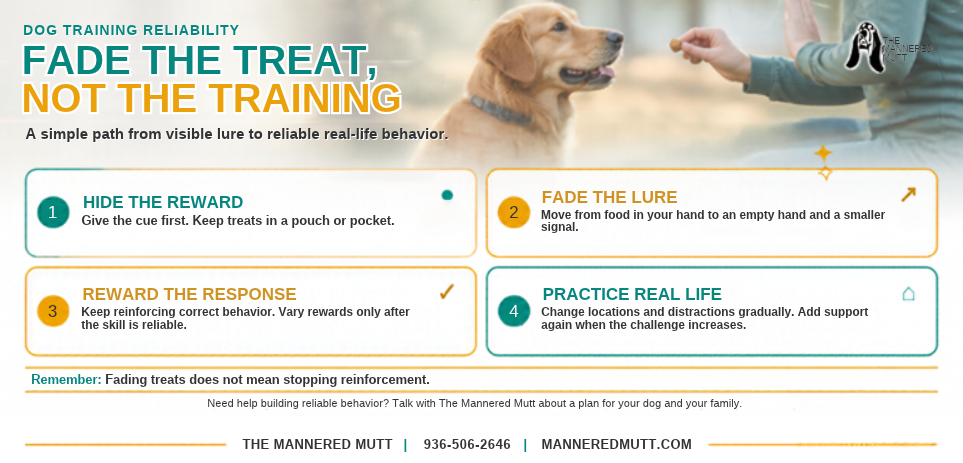
1. Hide the reward before you give the cue
2. Change one part of the exercise
3. Track the actual response
4. Reward the behavior you want to keep
5. Bring food back when the challenge increases
Why Does my Dog Only Listen for Treats?
- Does my dog respond when the treat is hidden?
- Does my dog know the cue in this location?
- Am I changing the location, distance, duration, and distraction all at once?
- Is the reward valuable enough for this situation?
- Am I rewarding promptly after the behavior?
- Does the behavior sometimes lead to a better real-life reward?
When Should you Seek Professional Help?
How can The Mannered Mutt Help?
FAQs
Will my dog always need treats?
Your dog does not need to see a treat before every cue, but reliable behavior still needs reinforcement. You can use hidden food, praise, play, attention, sniffing, access, and other rewards that matter to your dog.
How do I fade a lure?
Move from food in the guiding hand to an empty hand, then gradually make the hand signal smaller while rewarding after the behavior. If the response falls apart, make the exercise easier and provide more help before trying to fade again.
Is using treats in dog training bribery?
Food used to guide a new movement is a lure, while food delivered after a behavior can function as a reinforcer. Showing food before every cue may create dependence on the visible treat, so keep rewards hidden and fade the prompt gradually.
What can replace food rewards?
Depending on the dog and situation, praise, play, attention, permission to sniff, moving forward, or returning to an appropriate activity can function as rewards. A replacement reward only helps if the dog actually values it at that moment.
Why does my dog listen at home but not outside?
Dogs do not automatically generalize a behavior from one location to another, and outdoor distractions may be more valuable than the reward you are offering. Practice the cue in gradually harder settings, change one variable at a time, and reward successful responses.
